All Starship flights: a guide to the 15 launches
Updated on November 27, 2026.
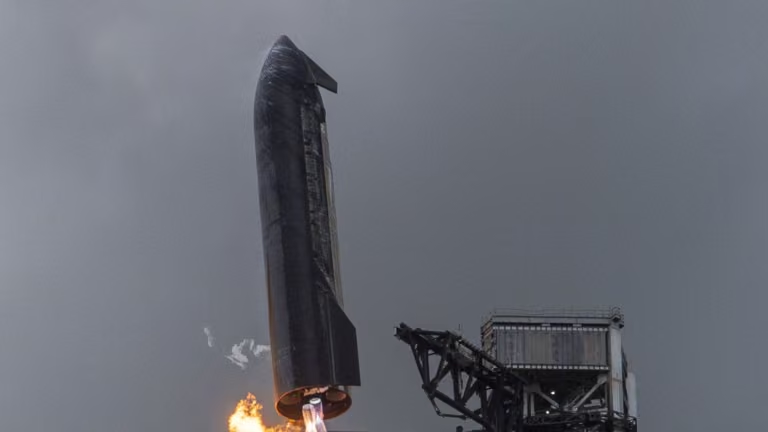
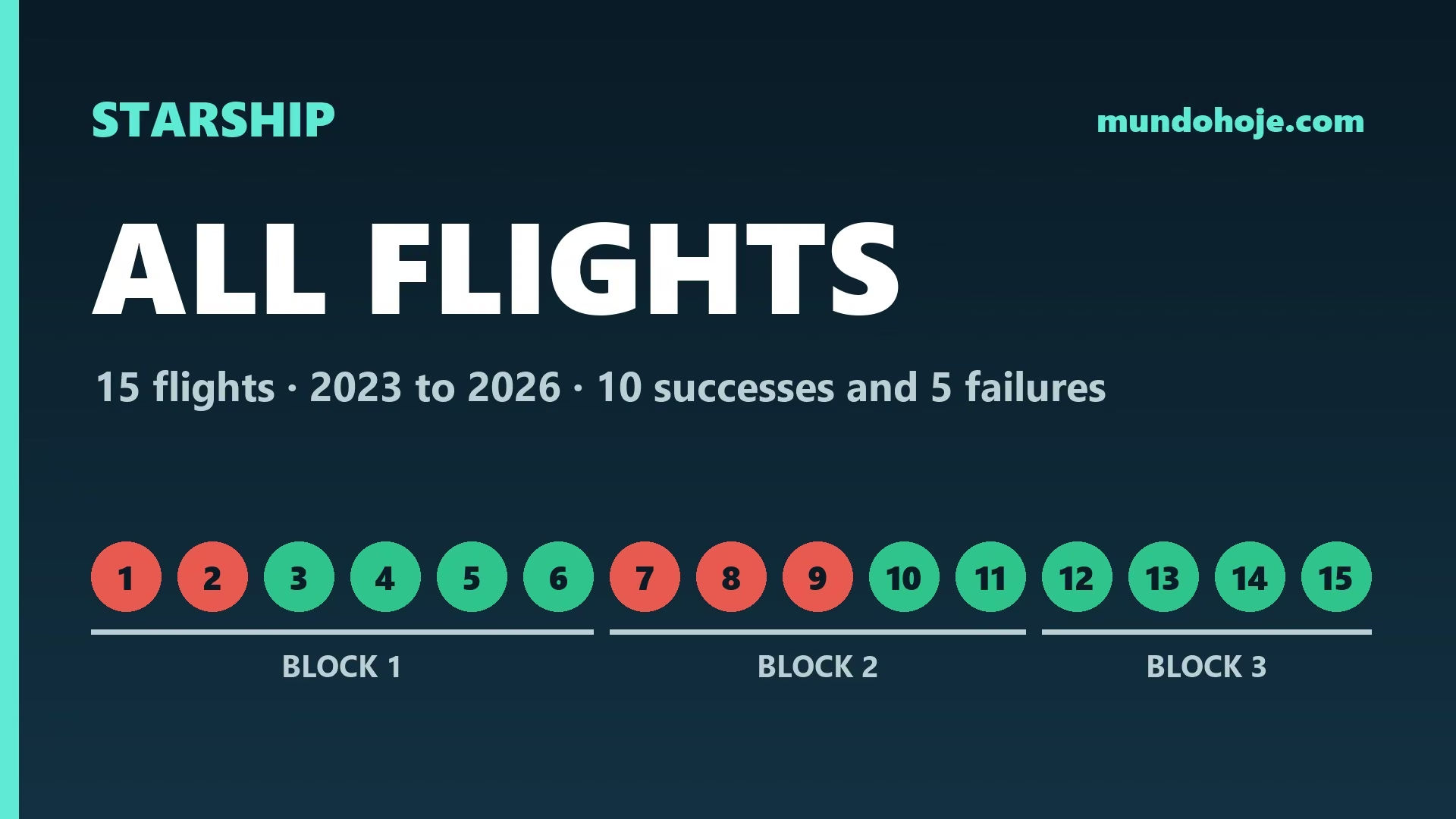
Starship, SpaceX’s rocket, has flown 15 times, from April 20, 2023 to November 13, 2026. Every launch left from Starbase, in Texas. According to Wikipedia, ten were classed as successes and five as failures. This page gathers the 15 flights in a single table. It is the map of the series. That is three years and seven months of testing. Each row leads to the flight’s reference post, with the fact sheet, the order of events and the lesson it left.
The 15 flights in one table
| Flight | Date | Vehicles | Booster | Ship | Result |
|---|---|---|---|---|---|
| Flight 1 | Apr 20, 2023 | Block 1 · B7 / S24 | did not get there | did not get there | Failure |
| Flight 2 | Nov 18, 2023 | Block 1 · B9 / S25 | lost (Gulf) | did not get there | Failure |
| Flight 3 | Mar 14, 2024 | Block 1 · B10 / S28 | lost (Gulf) | lost before splashdown | Success |
| Flight 4 | Jun 6, 2024 | Block 1 · B11 / S29 | controlled descent (Gulf) | controlled splashdown | Success |
| Flight 5 | Oct 13, 2024 | Block 1 · B12 / S30 | caught by the tower | controlled splashdown | Success |
| Flight 6 | Nov 19, 2024 | Block 1 · B13 / S31 | return aborted | controlled splashdown | Success |
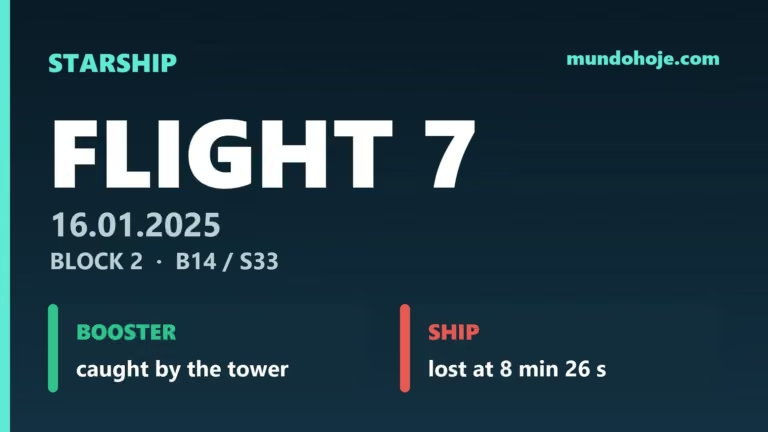
| Flight 7 | Jan 16, 2025 | Block 2 · B14-1 / S33 | caught by the tower | did not get there | Failure |
| Flight 8 | Mar 6, 2025 | Block 2 · B15-1 / S34 | caught by the tower | did not get there | Failure |
| Flight 9 | May 27, 2025 | Block 2 · B14-2 / S35 | lost (Gulf) | lost before splashdown | Failure |
| Flight 10 | Aug 26, 2025 | Block 2 · B16 / S37 | controlled descent (Gulf) | controlled splashdown | Success |
| Flight 11 | Oct 13, 2025 | Block 2 · B15-2 / S38 | controlled descent (Gulf) | controlled splashdown | Success |
| Flight 12 | May 22, 2026 | Block 3 · B19 / S39 | lost (Gulf) | controlled splashdown | Success |
| Flight 13 | Jul 24, 2026 | Block 3 · B20 / S40 | lost (Gulf) | controlled splashdown | Success |
| Flight 14 | Sep 28, 2026 | Block 3 · B21 / S41 | controlled descent (Gulf) | controlled splashdown | Success |
| Flight 15 | Nov 13, 2026 | Block 3 · B22 / S42 | return aborted; lost in the Gulf | caught by the tower | Success |
The result column follows Wikipedia’s classification as of November 14, 2026. It rates the flight as a whole, which is why a flight can be a “success” even with the booster lost, as with flights 12 and 13.
How the series divides
The first six flights used the first generation, Block 1. They were tests of ascent and separation, plus reentry, taken one step at a time. On flight 4, the booster came down under control in the Gulf and the ship splashed down on command. On flight 5, the Starbase tower caught the booster for the first time.
Block 2 debuted on flight 7 and ran through flight 11. The tower caught the booster on flights 7 and 8, but the ship failed on both. On flight 9, the booster and the ship were both lost. It was a hard start. Then came two successes. Flights 10 and 11 closed out the generation with their objectives met.
Block 3, also called V3, debuted on flight 12, with Raptor 3 engines and a second pad, OLP-2. It was the generation of the Starlink V3s and of the first orbit. A big turn. Flight 14 was the first to enter orbit, and flight 15 the first to bring the ship back from orbit and hold it in the tower’s arms. The booster, however, was lost.
The series’ firsts
- Flight 5: the first booster catch by the tower.
- Flight 9: the first reused booster.
- Flight 10: the first payload release in flight, with satellite simulators.
- Flight 12: the first launch of Block 3 and of pad OLP-2.
- Flight 13: the first Starlink V3 satellites released by Starship.
- Flight 14: Starship’s first orbit, with 26 satellites.
- Flight 15: the first catch of the ship by the tower.
The results in numbers
Of the 15 flights, ten were successes and five were failures, by Wikipedia’s classification. Two failures came in 2023, on flights 1 and 2, and three in 2025, between flights 7 and 9. Since flight 10, no flight has been classed as a failure. That is six in a row. The numbers show a learning curve: five failures in the first nine flights, then six flights without one, even with a new generation of vehicles.
The tower caught the booster three times, on flights 5 and 7 and again on 8. Since flight 12, no booster has returned to the tower. Flights 12 and 13 failed on landing, flight 14 dropped under control into the Gulf, and flight 15’s return was aborted. The booster is the open question.
The ship has had a better path, and the table shows it. It is the part that works. It failed only before flight 10, and since then it has finished every flight under control, whether in the sea or in the tower’s arms, as on flight 15. That is the success story.
How to read the table
- Block 1, 2 and 3: Starship’s three generations, from oldest to newest.
- B and S: the number of the Super Heavy booster (B) and of the Starship ship (S). A number with a dash, like B14-2, marks the same booster’s second flight.
- Did not get there: the flight ended before the point where that result would be measured.
- Controlled: the vehicle finished the flight under command, at the planned place.
- OLP-1 and OLP-2: Starbase’s two launch pads. OLP-1 was used through flight 11, and OLP-2 from flight 12 on.
Quick questions
How many flights has Starship made?
There have been 15 flights, from April 20, 2023 to November 13, 2026.
How many were successful?
Ten were classed as successes and five as failures, according to Wikipedia.
Which was the first orbital flight?
Flight 14, on September 28, 2026.
When was the ship caught by the tower?
On flight 15, on November 14, 2026, after about 22 and a half hours in space.
Sources: List of Starship launches, English Wikipedia, and each flight’s official page on spacex.com. The details of each flight are in the posts linked in the table. Accessed November 27, 2026.
Featured image: Mundo Hoje graphic, with data from Wikipedia.