Starship flight 7: the Block 2 debut, with the ship lost
Updated on November 26, 2026.
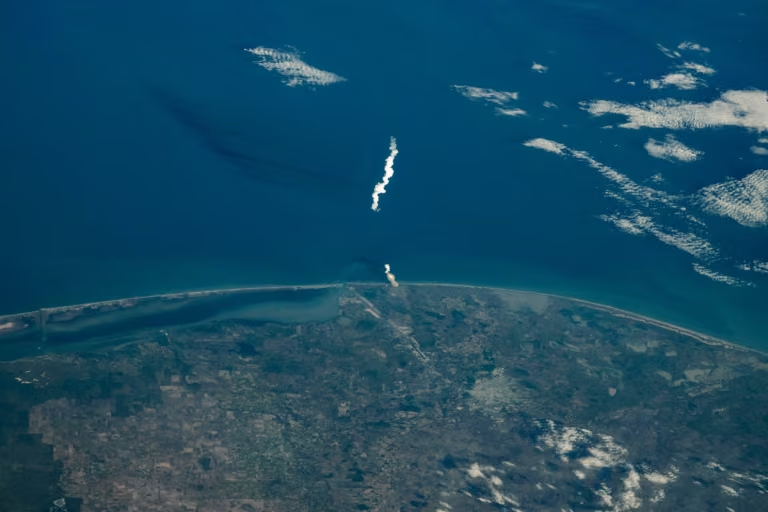
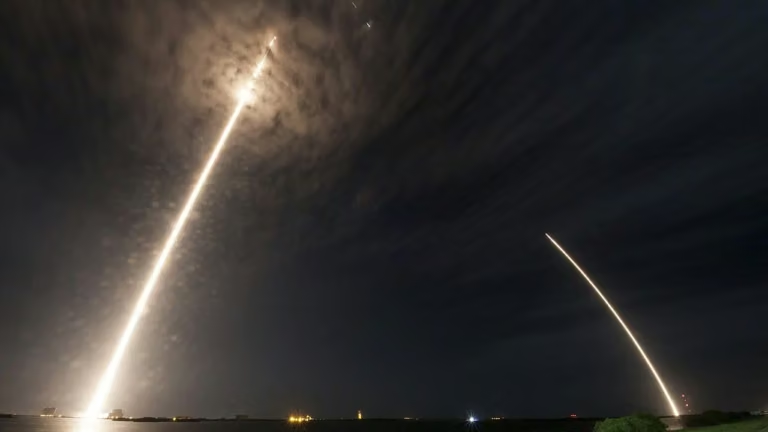
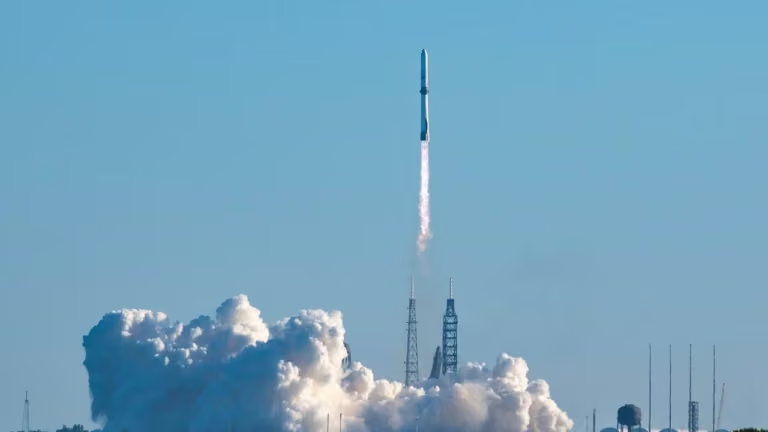
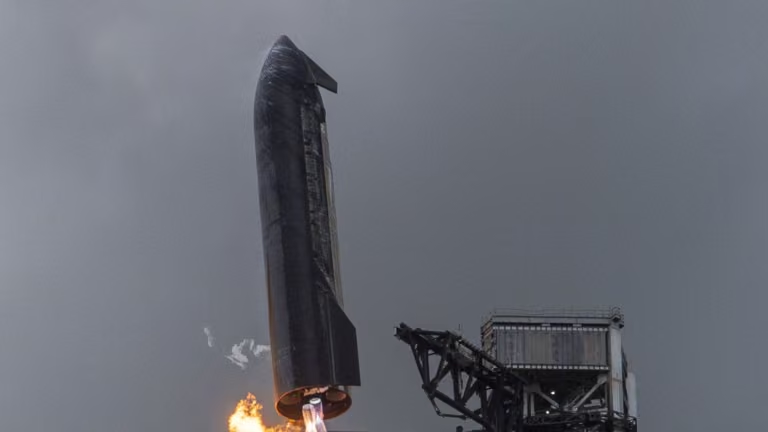
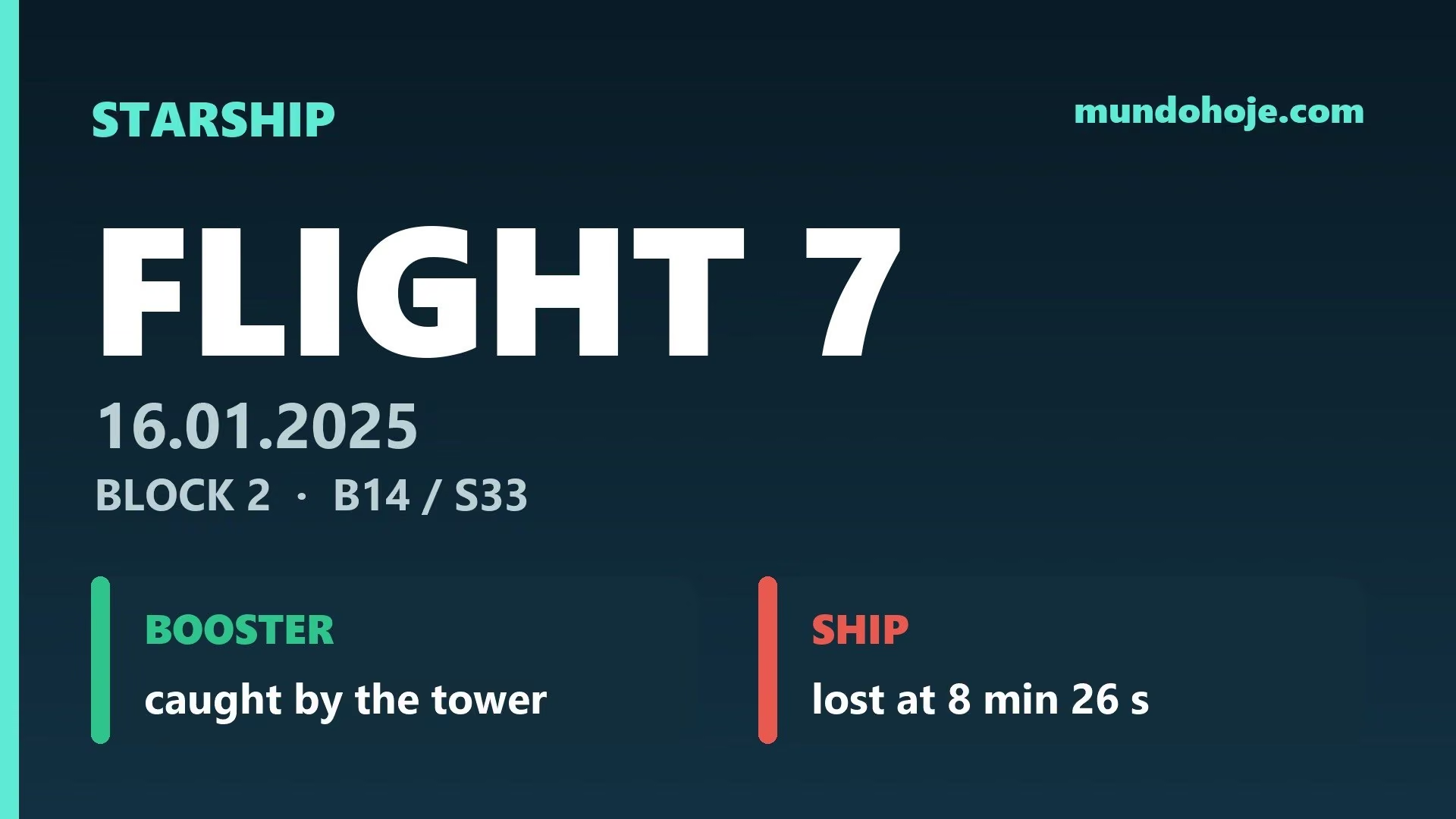
Starship flight 7 lifted off from Starbase, Texas, on Thursday, January 16, 2025, at 4:37 p.m. local time (5:37 p.m. Eastern). It was the debut of the Block 2 version of the ship, Ship 33. The Super Heavy booster flew back and was caught by the tower, the second catch in history. The ship, however, lost its engines one by one on the way up. Telemetry was lost at 8 minutes and 26 seconds, and it broke apart over the Caribbean about three minutes later. No one was hurt. It was the first loss of a Block 2.
Flight 7 at a glance
| Item | Detail |
|---|---|
| Date and time | January 16, 2025, 22:37 UTC (4:37 p.m. CST at Starbase) |
| Site | Starbase, Texas, orbital launch pad OLP-1 |
| Booster | Super Heavy Booster 14 (B14), Block 2 |
| Ship | Starship Ship 33 (S33), the first Block 2 |
| Planned payload | 10 Starlink satellite simulators, about 44,000 lb (20,000 kg) |
| Planned trajectory | Suborbital, with a splashdown in the Indian Ocean about 1 hour later |
| Ship lost | Telemetry lost at 8 min 26 s, at 91 miles (146 km) altitude |
| Result | Ship failure; booster caught by the tower |
What the flight was meant to test
The new ship brought changes to its structure and avionics, among other systems, and it was the first of a whole generation. With Block 2, the full stack beat its own record. It became the heaviest object ever launched again, at about 12 million pounds (5.5 million kg) at liftoff. According to Wikipedia, it also stood about 6 feet 7 inches (2 meters) taller than the Block 1 stack.
The plan called for a flight similar to flight 6, with a splashdown in the Indian Ocean, and a test of a new Starlink satellite deployment system. Ten simulators would be released, and the ship was to relight an engine in space. NASA planned to film reentry with a special aircraft, a Gulfstream V.
What happened, in order
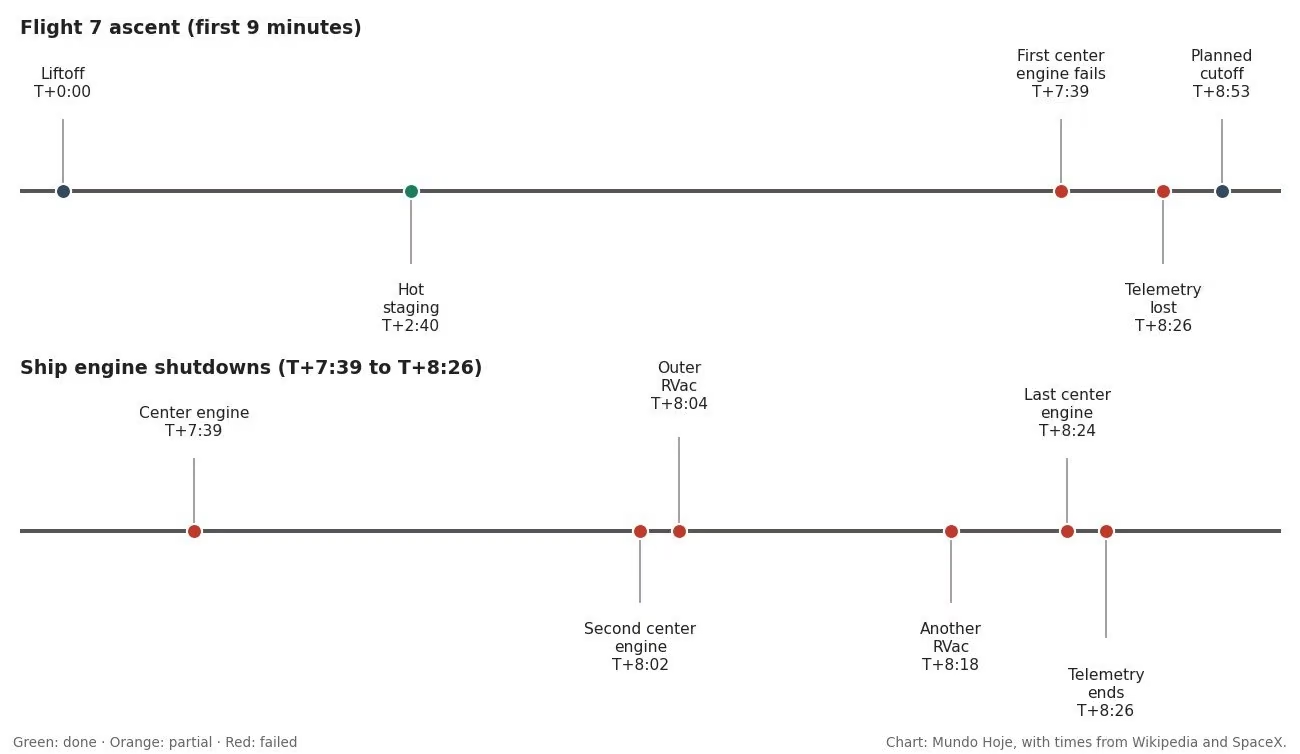
- Ascent: the booster’s 33 engines gave a normal ascent. Hot staging came at 2 min 40 s, and the ship lit its six Raptors.
- Booster return: on the boostback burn, 12 of the 13 planned engines relit. The other aborted because of a problem in the ignition system, which later units were already due to fix. On the landing burn, all 13 lit.
- Catch: the tower arms held the booster. It was the second catch, after the one on flight 5.
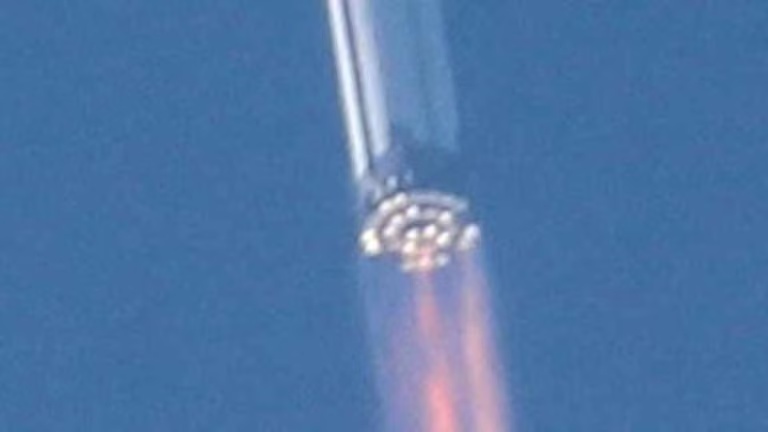
- Ship, ascent: a series of engine shutdowns began at 7 min 39 s with a center engine. At 8 min 02 s a second center engine failed, and at 8 min 04 s an outer vacuum engine. At 8 min 18 s, another outer one. At 8 min 24 s, the last center engine.
- End: telemetry vanished at 8 min 26 s, at 146 km altitude, 27 seconds before the planned shutdown. About three minutes later, the ship exploded over the Turks and Caicos Islands.
Debris fell across the Caribbean, in Puerto Rico and in the British Virgin Islands. Damage to structures was minimal. Airspace in the region was closed for more than an hour, and the FAA ordered SpaceX to investigate the accident.
What the investigation found
Soon after, Elon Musk said the likely cause was an oxygen and fuel leak in the cavity above the engine firewall. It was big enough to build more pressure than the venting could handle. On February 24, 2025, SpaceX gave the technical explanation. A vibration response several times stronger in flight than in testing raised stress on the propulsion system and caused propellant leaks. That led to fires in the aft section. The autonomous flight safety system destroyed the vehicle.
The FAA closed the investigation on March 28, 2025. It announced the closure on March 31. The probable cause: stronger-than-expected vibrations led to excess stress and the failure of propulsion hardware. SpaceX adopted 11 corrective actions before flight 8, and the agency verified they were done.
Objective by objective
| Objective | Result |
|---|---|
| Debut of the Block 2 ship | Flew, but lost on ascent |
| Booster catch | Done, for the second time |
| Ship ascent to the end of the burn | No: engines shut down from 7 min 39 s |
| New satellite deployment system | Never used |
| In-space relight and splashdown | Never reached |
What islanders said
On January 25, the disaster management office of the Turks and Caicos government and the British air accident investigation body met SpaceX to agree on the cleanup. SpaceX said the debris held no hazardous materials and that the flight stayed inside its authorized corridor, with debris expected in areas analyzed beforehand with the FAA.
Still, there was pushback. Residents feared that rapid, iterative development could cause similar incidents in the future and put at risk those who live or fly in the region. SpaceX asked that no one try to collect the debris and opened a hotline for reports.
What changed for flight 8
Flight 8 was on March 6, 2025, with Booster 15 and Ship 34, both Block 2, and with 4 Starlink simulators. According to Wikipedia’s table, the booster was caught again and the ship was lost again. See Starship flight 8.
Quick glossary
- Block 2: the second version of Starship, taller and with redesigned systems; it debuted on this flight.
- Telemetry: data the vehicle sends to Earth during flight.
- Autonomous flight safety system: equipment that destroys the vehicle if it leaves its corridor or loses control.
Common mix-ups
- “Flight 7 was a total failure”: no. The booster was caught for the second time.
- “The ship fell on someone”: no one was hurt, and the reported damage was minimal.
- “It was a routing error”: the investigation pointed to stronger-than-expected vibration.
The rule to remember
A debut flight tests what no one can test on the ground. In-flight vibration was far stronger than what testing measured, and that gap cost the ship, but it produced 11 fixes before the next flight.
Quick questions
When was Starship flight 7?
On January 16, 2025, at 4:37 p.m. local time at Starbase.
What went wrong?
The ship lost its engines on ascent, lost telemetry at 8 min 26 s and broke apart over the Caribbean.
Was the booster recovered?
Yes. The tower arms caught it, for the second time.
Was anyone hurt?
No. The FAA confirmed there were no public injuries.
When was flight 8?
On March 6, 2025.
Previous flight: Starship flight 6
Sources: Starship’s Seventh Flight Test, SpaceX, January 16, 2025; Starship flight test 7, English Wikipedia; List of Starship launches, English Wikipedia. Accessed November 26, 2026. Eastern time calculated from UTC.
Featured image and text image: Mundo Hoje graphics, with data from SpaceX and Wikipedia.