Reusable Rockets: How They Work and Who Has Landed One
Updated November 2, 2026.
A reusable rocket has parts that come back to Earth and fly again. The goal is to lower the cost of each launch. The math looks simple. According to Wikipedia, the first reusable stages flew only with the space shuttle, in 1981. A vertical landing of an orbital booster came on December 21, 2015, with SpaceX. It was a turning point. Since then, other companies and China have joined the race. The field is crowded.
How the idea works
On an ordinary rocket, the first stage falls into the ocean and is lost. On a reusable one, it comes back, touches down and is inspected so it can fly again. The savings depend on how much it costs to recover and refurbish each part of the rocket after every flight. Wikipedia itself warns that refurbishment can be slow and expensive, which can cancel part of the savings. That matters a great deal for the final price of a launch.
The space shuttle was the first case. It flew for 30 years. It flew from 1981 to 2011. The last flight was STS-135, which landed on July 21, 2011.
SpaceX’s Falcon 9
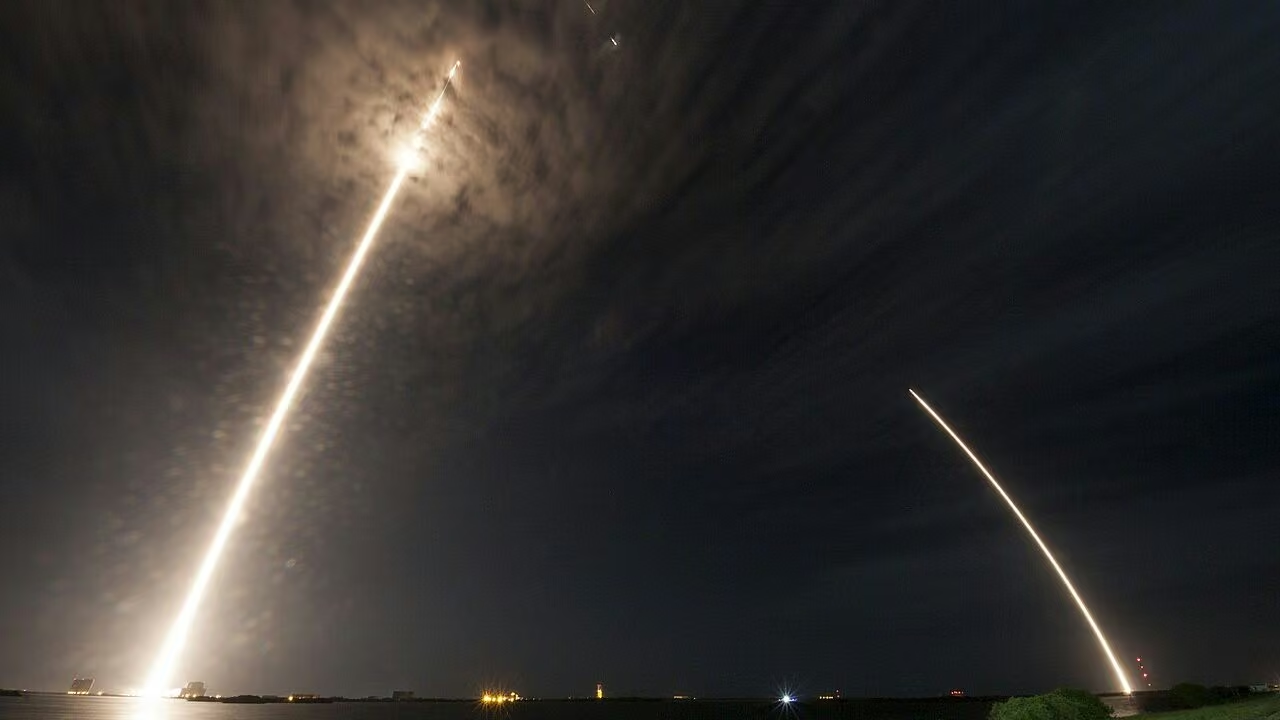
SpaceX made the first vertical landing of an orbital-class rocket stage on December 21, 2015. The first reuse of a Falcon 9 first stage came on March 30, 2017, more than a year after that first landing. The current record belongs to booster B1067, which, as of September 9, 2026, had launched and landed 37 times. That is a lot.
Starship takes a different approach. Its Super Heavy booster is caught in midair by arms on the launch tower, a system Wikipedia describes as chopsticks. The most recent Starship flight Wikipedia lists is number 14, on September 28, 2026.
Blue Origin and Rocket Lab
Blue Origin’s New Glenn landed its first stage on a barge in the Atlantic on November 13, 2025. It was the company’s first landing. The same booster flew again on April 19, 2026.
Rocket Lab recovered an Electron first stage on November 20, 2020. Nine boosters had been recovered by January 2024, according to Wikipedia. After that, the company stopped reflying them. It shifted its focus to Neutron, which will be partially reusable. That is a bigger rocket.
China
On July 10, 2026, the Long March 10B made its first flight and recovered its first stage. Wikipedia says it was the first recovery of this kind in China and the first outside the United States. It was a milestone.
Earlier attempts failed. Landing is hard. Zhuque-3 reached orbit on December 3, 2025. Long March 12A followed on December 23. Both lost their first stages in landing attempts. On February 11, 2026, the first stage of the Long March 10 made a soft landing in the water during the Mengzhou abort test.
| Date | Milestone |
|---|---|
| 1981 | The space shuttle introduces reusable stages |
| December 21, 2015 | First vertical landing of an orbital stage, by Falcon 9 |
| March 30, 2017 | First reuse of a Falcon 9 first stage |
| November 20, 2020 | Rocket Lab recovers an Electron stage |
| November 13, 2025 | New Glenn lands its first stage on a barge |
| July 10, 2026 | Long March 10B recovers its first stage, a first for China |
| September 9, 2026 | Booster B1067 reaches 37 flights |
Frequently asked questions
What is a reusable rocket?
It is a rocket with parts that return to Earth, are recovered and then fly again. The goal is to lower the cost of each launch.
Who was the first to land an orbital rocket?
SpaceX, on December 21, 2015, with a Falcon 9 first stage that came down vertically and landed in one piece on a pad.
How many times has a single Falcon 9 flown?
The record is 37 flights, set by booster B1067, as of September 9, 2026, according to the Wikipedia page on reusable launch vehicles.
Has China landed a rocket?
Wikipedia records China’s first first-stage recovery on July 10, 2026, with the Long March 10B. Before that, two landing attempts ended in failure, in December 2025.
Does reuse always save money?
It can cut launch costs a lot, but refurbishing each part can be slow and expensive, and that eats into the savings that reuse is supposed to bring.
Read next: NASA Explained and NASA’s Artemis Program: Why America Is Going Back to the Moon.
Sources: Reusable launch vehicle, Wikipedia.
Featured image: SpaceX, CC0, via Wikimedia Commons.