Starship flight 13: the first Starlink V3 satellites and an intact ship at sea
Updated on November 27, 2026.
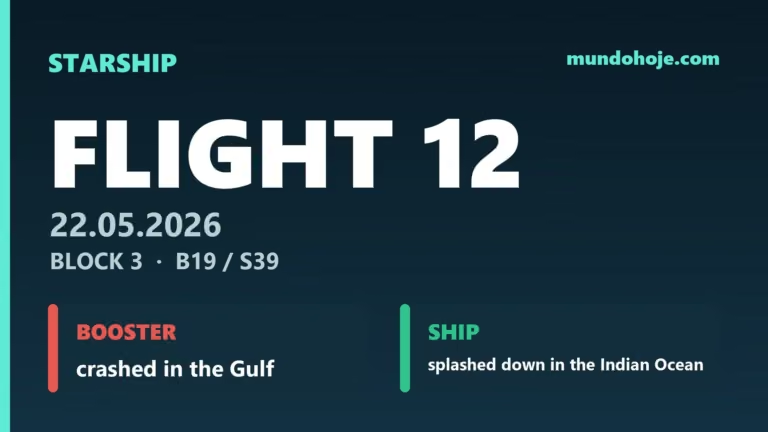
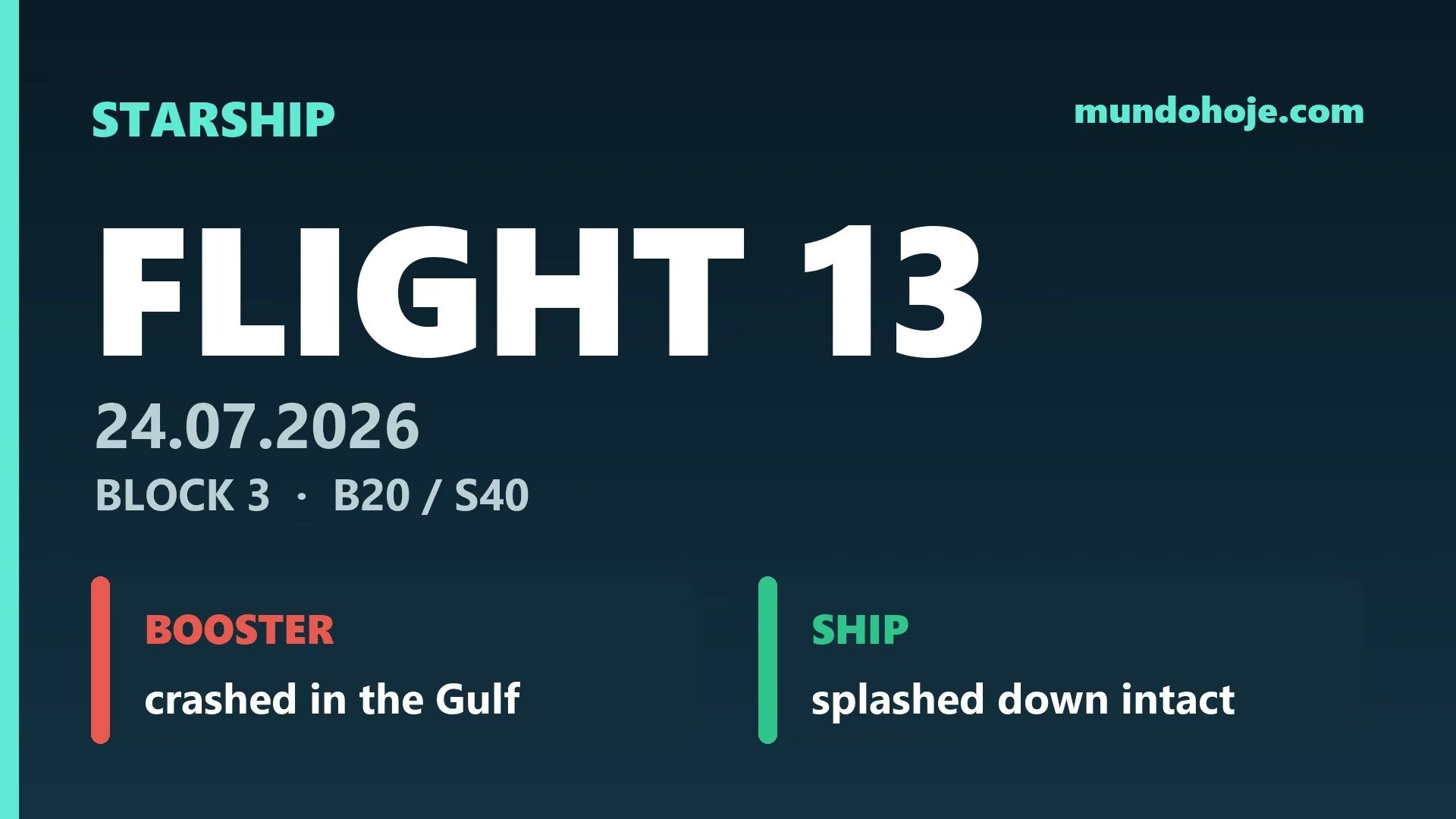
Starship flight 13 lifted off from Starbase, Texas, on Friday, July 24, 2026, at 5:51 p.m. local time (6:51 p.m. Eastern). It was the second flight of the V3 vehicles and the first in which Starship released the next-generation Starlink V3 satellites. The ship released 20 of them, relit a Raptor in space and splashed down in the Indian Ocean. It stayed whole in the water, a first for the vehicle. The booster, however, repeated the problem of flight 12: its landing burn failed, and it crashed in the Gulf.
Flight 13 at a glance
| Item | Detail |
|---|---|
| Date and time | July 24, 2026, 22:51 UTC (5:51 p.m. CDT at Starbase) |
| Site | Starbase, Texas, orbital launch pad OLP-2 |
| Booster | Super Heavy Booster 20 (B20), Block 3, with 33 Raptor 3 engines |
| Ship | Starship Ship 40 (S40), Block 3 |
| Payload | 20 Starlink V3 satellites, six of them with cameras, according to Wikipedia |
| Ship trajectory | Suborbital, with a splashdown in the Indian Ocean |
| Duration | A little over 1 hour and 5 minutes |
| Result | Mixed: ship intact at sea; booster lost in the Gulf |
Before the flight
After flight 12, the FAA required an investigation. According to Wikipedia, it finished its review on July 13 and cleared the next launches. Flight 13 came eleven days later. It was the second time Pad 2 hosted a launch, and SpaceX arrived with the first Block 3 investigation already closed.
The first attempt was on July 16. It did not go. The countdown aborted by itself, at ignition, because of problems with Raptor engines. The second, planned for July 23, was postponed because of bad weather, and the date ended up pushed to the following Friday, the 24th. The third worked.
What the flight was meant to test
SpaceX described the flight as the second of the V3 vehicles and the first to release the Starlink V3s, the next-generation satellites of the network the company operates. The booster had a modified startup sequence, to better tolerate variation in engine start timing and flip in the desired direction. The ship would release the 20 satellites, relight a Raptor and make its reentry with a dynamic banking move.
What happened, in order
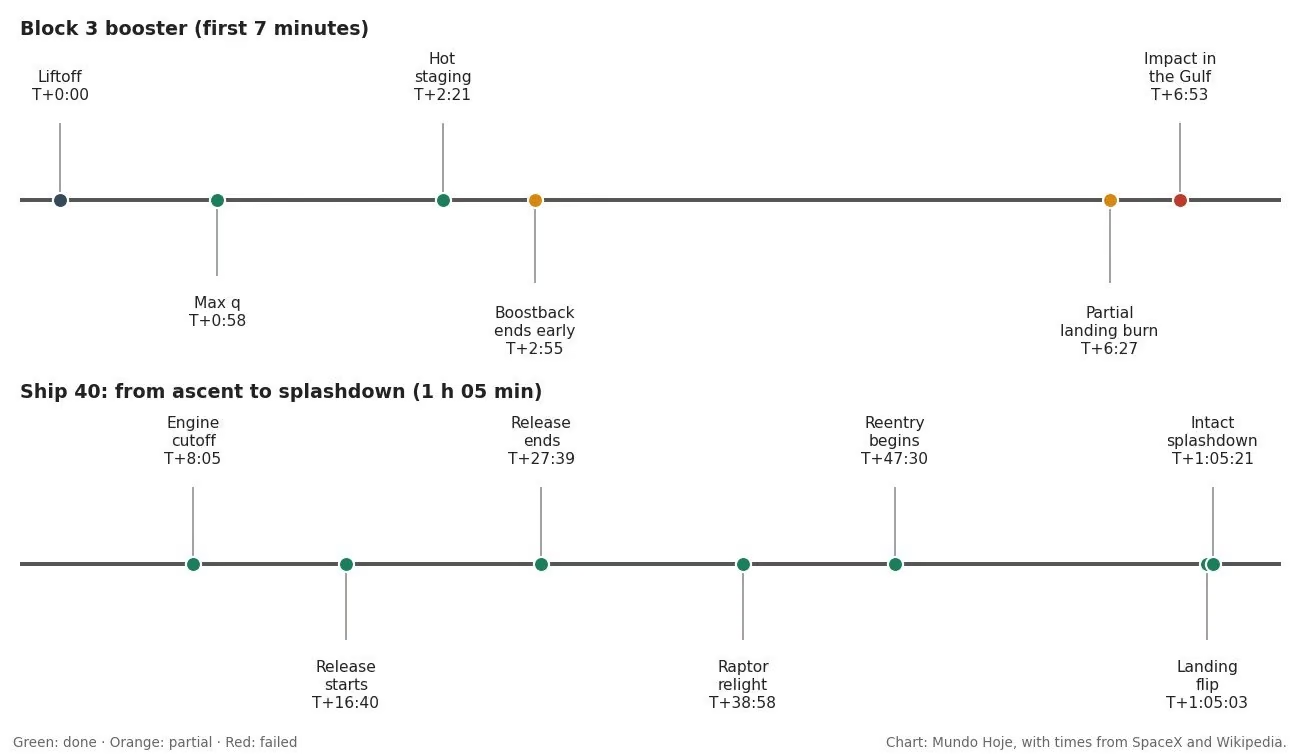
- Ascent: all 33 Raptor 3 engines lit and the first stage climbed without problems. Maximum aerodynamic pressure came at 58 s, and hot staging at 2 min 21 s, by SpaceX’s timeline.
- Booster, return: after the flip, it completed the high-thrust part of the boostback burn with all 33 engines, the first time for a Super Heavy V3. The burn, however, ended early.
- Booster, landing: it tried to relight for the landing burn, and only some of the engines lit. According to Wikipedia, it was ten of the 13 planned, and several shut down right after. The booster hit the water in the Gulf and was destroyed.
- Ship, ascent: all six Raptor engines completed the full burn, and the ship reached its planned speed and trajectory.
- Satellites: the release of the 20 Starlink V3s took place between 16 min 40 s and 27 min 39 s. SpaceX talked to all of them by radio and by laser. It also downloaded important data from each one.
- Relight: at 38 min 58 s, the ship relit a single Raptor in space, a demonstration of a capability needed for future orbital missions.
- Reentry: it began at 47 min 30 s. The ship gathered heat shield data and made the dynamic banking move, imitating the return to Starbase.
- Splashdown: transonic at 1 h 02 min 23 s, subsonic at 1 h 03 min 01 s. It relit its three center engines, made the landing flip at 1 h 05 min 03 s, and the burn dropped from 3 to 2 and then to 1 engine. It touched the ocean at 1 h 05 min 21 s and stayed intact.
What the satellites did
The 20 satellites followed a planned suborbital trajectory, the same as the ship’s. SpaceX says they are expected to have burned up on reentry, about 20 minutes after release, without ever entering orbit. That was the plan. According to Wikipedia, six carried advanced cameras to inspect the ship.
The intact ship
For the first time, SpaceX had images of a whole heat shield after reentry. It was a novelty. Wikipedia says the ship stayed operational after tipping over in the water, which let a drone inspect the shield and the engines.
Objective by objective
| Objective | Result |
|---|---|
| Booster ascent and separation | Done, with all 33 engines |
| Full boostback burn | Partial: high thrust with 33 engines, but it ended early |
| Booster landing burn | No: only some engines lit |
| Ship ascent on all six engines | Done, at the planned speed and trajectory |
| Release 20 Starlink V3 satellites | Done, the first time |
| Talk to the satellites by radio and laser | Done, with all of them |
| Relight a Raptor in space | Done |
| Reentry and dynamic banking | Done, with data collected |
| Soft splashdown in the Indian Ocean | Done, with the ship intact |
What changed for flight 14
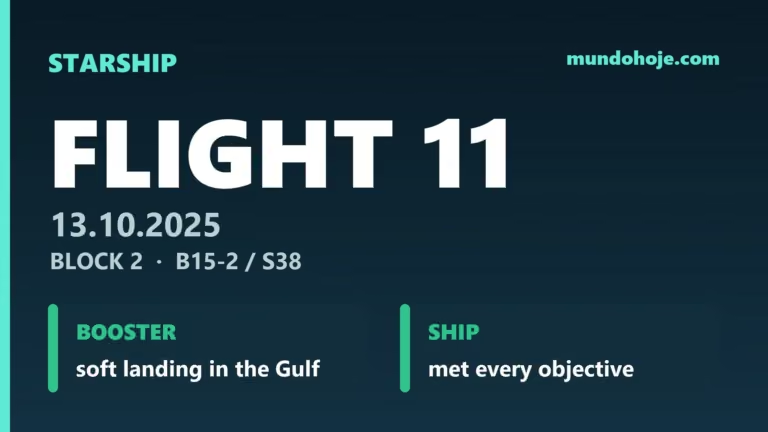
Flight 14 was on September 28, 2026, with Booster 21 and Ship 41. According to Wikipedia, it was the first flight in which the ship reached Earth orbit, with 26 Starlink V3 satellites. See Starship flight 14.
Quick glossary
- Starlink V3: the new generation of Starlink satellites, launched by Starship.
- High thrust: the first part of the boostback burn, with all engines lit.
- Dynamic banking: a maneuver in which the ship tilts its body on the way down, imitating the flight back to Starbase.
- Suborbital trajectory: the path that goes up and comes back to Earth without completing an orbit.
- Heat shield: the tiles that protect the ship from the heat of reentry.
Common mix-ups
- “Flight 13’s satellites are in orbit”: no. They followed the ship’s suborbital trajectory and were expected to burn up on reentry.
- “Flight 13 failed”: it was mixed. The ship completed the script; the booster did not.
- “The ship was recovered”: it stayed intact in the water, but it splashed down in the Indian Ocean and was not brought back.
The rule to remember
A flight can be good and bad at the same time. Flight 13 gave SpaceX the proof it was missing on the ship, with satellites released and the shield in view. The booster, which has to come back whole for the math to close, has not passed the test yet.
Quick questions
When was Starship flight 13?
On July 24, 2026, at 5:51 p.m. local time at Starbase.
What was new?
The first Starlink V3 satellites released by Starship and a ship that stayed intact in the water.
Was the booster recovered?
No. It crashed in the Gulf after a partial landing burn.
When was flight 14?
On September 28, 2026.
Previous flight: Starship flight 12
Sources: Starship’s Thirteenth Flight Test, SpaceX, July 24, 2026; Starship flight test 13, English Wikipedia; List of Starship launches, English Wikipedia. Accessed November 27, 2026. Eastern time calculated from UTC; flight times are SpaceX’s approximate ones.
Featured image and text image: Mundo Hoje graphics, with data from SpaceX and Wikipedia.