Starship flight 14: Starship’s first orbit
Updated on November 27, 2026.
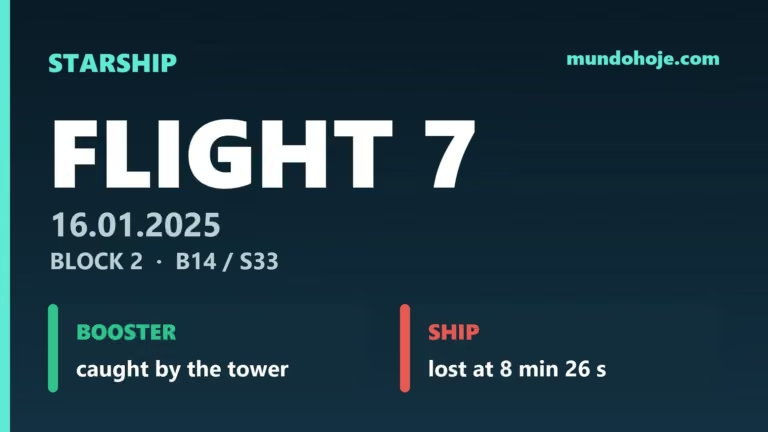
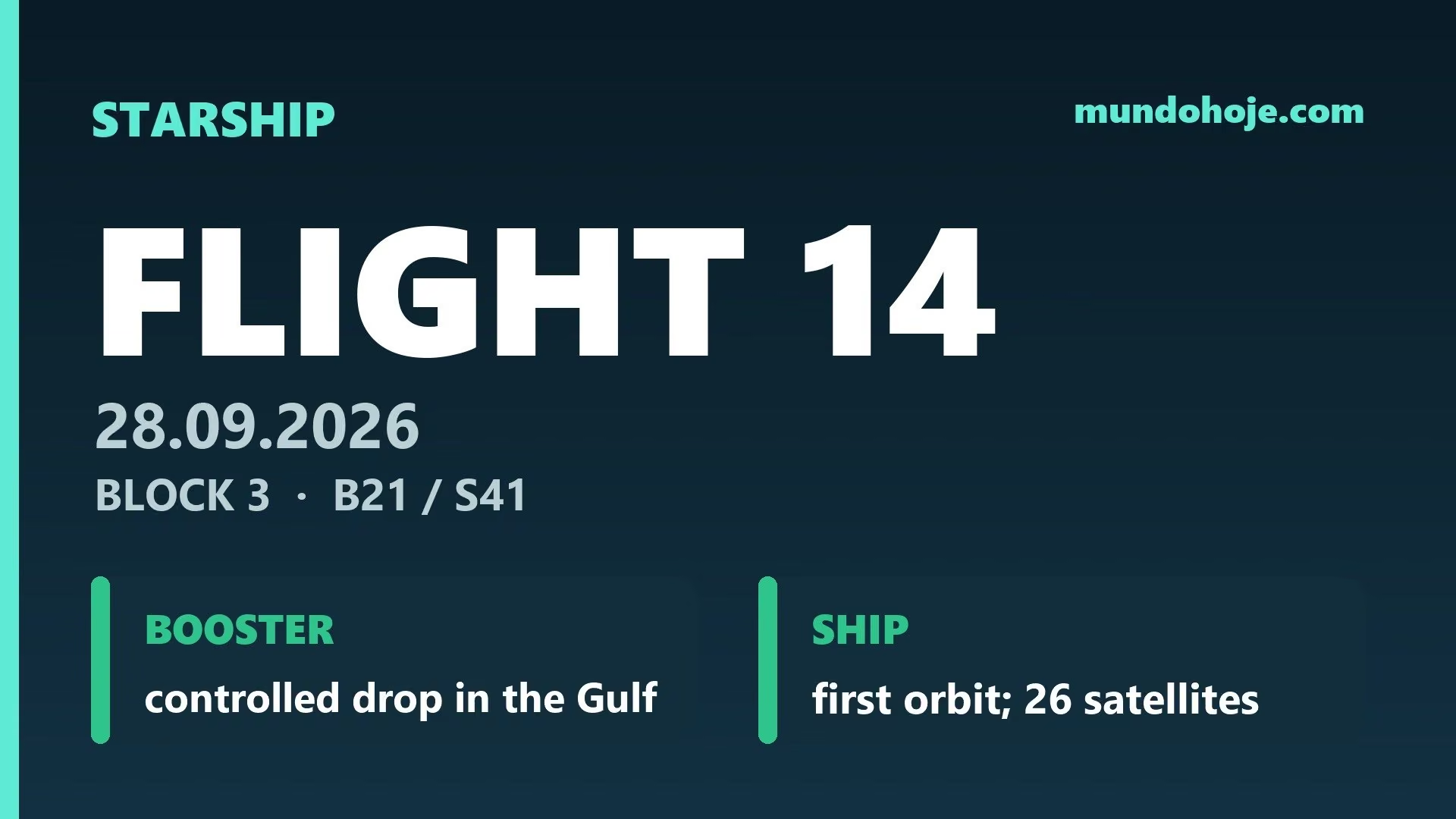
Starship flight 14 lifted off from Starbase, Texas, on Monday, September 28, 2026, at 7:48 a.m. local time (8:48 a.m. Eastern). It was Starship’s first orbital flight and the first to carry a real payload to orbit, with 26 Starlink V3 satellites. The 13 earlier flights had all been suborbital. The ship lost an engine on ascent and still reached orbit, released the satellites and came back to splash down in the Pacific Ocean. SpaceX cut the flight short as a precaution. It came 66 days after flight 13.
Flight 14 at a glance
| Item | Detail |
|---|---|
| Date and time | September 28, 2026, 12:48 UTC (7:48 a.m. CDT at Starbase) |
| Site | Starbase, Texas, orbital launch pad OLP-2 |
| Booster | Super Heavy Booster 21 (B21), Block 3, with 33 Raptor 3 engines |
| Ship | Starship Ship 41 (S41), Block 3 |
| Payload | 26 Starlink V3 satellites, three of them with cameras, according to Wikipedia |
| Ship trajectory | Low Earth orbit, with a return and splashdown in the North Pacific |
| Duration | About 3 hours and 8 minutes, according to Wikipedia |
| Result | Success: ship in orbit, satellites released and splashdown on target |
What the flight was meant to test
The flight was Starship’s first attempt to reach orbit. According to Wikipedia, the plan called for the insertion burn about 25 minutes after liftoff and the release of the 26 satellites. After that would come about six orbits, in a flight that would last nearly 10 hours. The return would be over the Pacific, west of Chile. Three of the satellites carried cameras, built to photograph the ship’s heat shield in orbit.
The booster had a test of its own. Its boostback burn was designed to use up the liquid oxygen left in the main tank. It was a limit test, a way to measure the vehicle’s limits before the future returns to the launch site.
What happened, in order
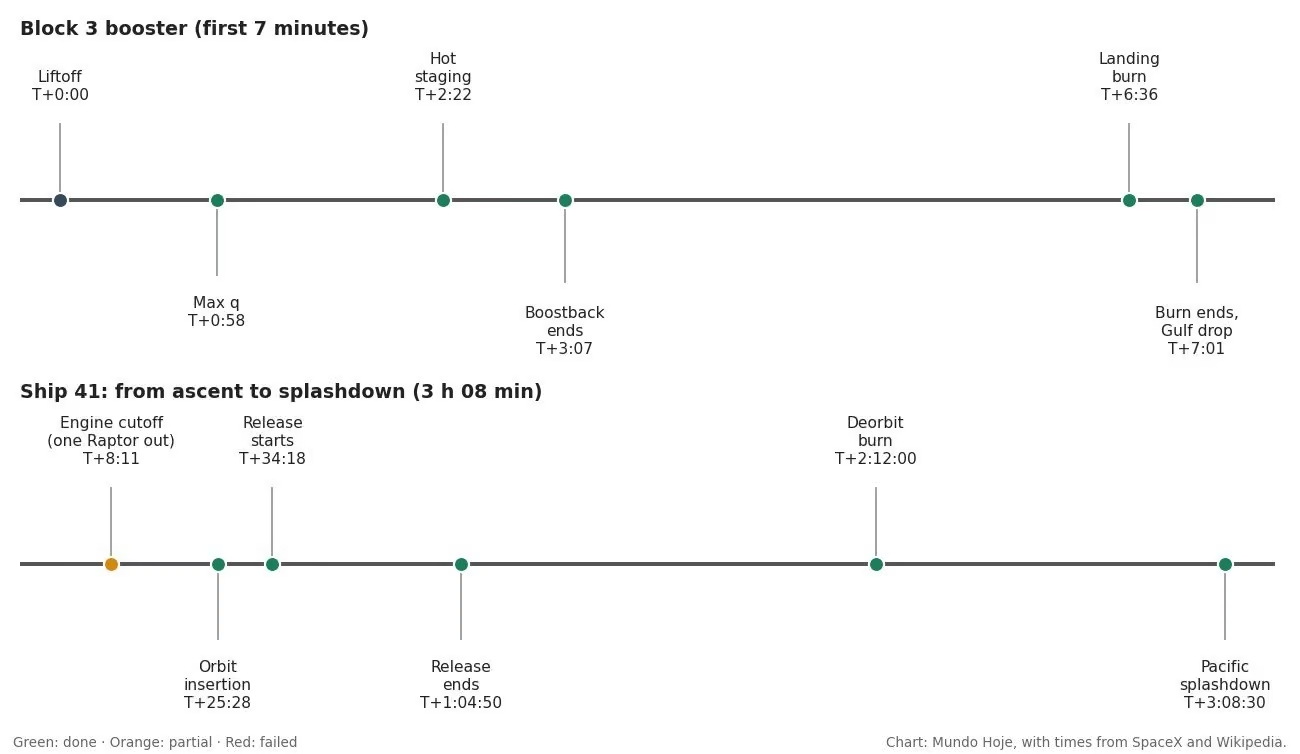
- Ascent: all 33 Raptor 3 engines lit, and one of them shut down during the initial climb. The first stage completed its ascent successfully. Maximum aerodynamic pressure came at 58 s, and hot staging at 2 min 22 s, by SpaceX’s timeline.
- Booster, return: after the directional flip, it relit 31 of the 33 planned engines for the boostback burn.
- Booster, landing: it lit 11 of the 13 planned engines in the high-thrust part of the landing burn. Then it cut down to five engines, to fine-tune its trajectory, and to three, before dropping into the Gulf. At the end of the burn, the flight termination system was triggered, in a demonstration of the safety hardware.
- Ship, ascent: one Raptor vacuum engine shut down early. The ship burned the other five longer to compensate and met its planned suborbital trajectory, safe even without another burn.
- Check: the flight control team assessed the systems, concluded that the three sea-level Raptors needed for the following burns were healthy, and gave the go for orbital operations.
- Orbit: the ship relit a single sea-level Raptor in the insertion burn, between 25 min 28 s and 25 min 47 s, according to Wikipedia. It entered Earth orbit for the first time.
- Satellites: after a brief coast, it released the 26 Starlink V3s, from 34 min 18 s to 1 h 04 min 50 s. SpaceX made contact with all of them, by laser, by ground stations and by user terminals.
- Early return: out of caution over the engine lost on ascent, the team limited the time in orbit. The deorbit burn, Starship’s first, came at 2 h 12 min 00 s, according to Wikipedia.
- Splashdown: with all three sea-level engines relit, the ship made its landing burn and flip. It splashed down on target in the Pacific, north of Hawaii, at 3 h 08 min 30 s, according to Wikipedia.
Why the flight was cut short
SpaceX says the vacuum engine lost on ascent weighed on the decision. The team preferred not to take a risk. It limited the time in orbit and brought the ship back to one of the two landing zones coordinated before launch. Wikipedia notes that the plan was six orbits, in nearly 10 hours, with a landing west of Chile. In practice, it was about 3 hours and a splashdown north of Hawaii.
What happens to the satellites
The 26 Starlink V3s stayed in orbit, which sets them apart from the satellites of flight 13. SpaceX says they would still run onboard checkouts and raise their orbits before starting to serve customers. Wikipedia cites an orbit of about 262 by 275 km in altitude, with an inclination of 30.5 degrees, but does not make clear whether those are planned or measured values.
Objective by objective
| Objective | Result |
|---|---|
| Ship ascent to the planned trajectory | Done, with one fewer vacuum Raptor |
| Orbit insertion burn | Done, Starship’s first |
| Release 26 Starlink V3 satellites | Done, with contact with all of them |
| Deorbit burn | Done, Starship’s first |
| Splashdown in the Pacific | Done, on target |
| Flight of about six orbits | No: cut short as a precaution |
| Booster boostback burn | Done, with 31 of the 33 engines |
| Booster landing burn | Done, with a controlled drop into the Gulf |
| Demonstrate the flight termination system | Done, at the end of the landing burn |
What changed for flight 15
Flight 15 was on November 13, 2026, with Booster 22 and Ship 42, carrying Starlink Group 31-2. Flight 14 had been Starlink Group 31-1. See Starship flight 15.
Quick glossary
- Low Earth orbit: an orbit a few hundred kilometers up, where many Starlink satellites sit.
- Insertion burn: the burn that puts the ship in orbit.
- Deorbit burn: the burn that takes the ship out of orbit and sends it back into the atmosphere.
- Passively safe: a trajectory that falls back to Earth on its own, without needing new burns.
- Flight termination system: the hardware that destroys the vehicle if it strays; here it was tested on purpose.
Common mix-ups
- “It was Starship’s first flight”: it was the 14th. It was the first in which it reached orbit.
- “The ship landed on land”: it splashed down in the Pacific, as planned.
- “Everything went as expected”: no. One booster engine and one ship engine failed, and the flight was cut short.
The rule to remember
Reaching orbit with an engine out proves more than reaching it with all of them. Flight 14 showed that the ship can take a failure and still complete its main mission. The price was accepting a flight shorter than planned.
Quick questions
When was Starship flight 14?
On September 28, 2026, at 7:48 a.m. local time at Starbase.
What was new?
Starship’s first orbit, its first deorbit burn and 26 Starlink V3 satellites released.
Was the booster recovered?
No. It dropped into the Gulf under control, and the flight termination system was triggered at the end of the burn.
When was flight 15?
On November 13, 2026.
Previous flight: Starship flight 13 · Next flight: Starship flight 15 · All flights: All Starship flights
Sources: Starship Flight 14, SpaceX, September 28, 2026; Starship flight 14, English Wikipedia; List of Starship launches, English Wikipedia. Accessed November 27, 2026. Eastern time calculated from UTC. Orbit and splashdown times are Wikipedia’s; SpaceX’s timeline shows the plan for a longer flight, and Wikipedia’s reentry times do not match each other, so they were not used.
Featured image and text image: Mundo Hoje graphics, with data from SpaceX and Wikipedia.