Starship flight 4: first flight with soft ocean landings of both stages
Updated on November 26, 2026.
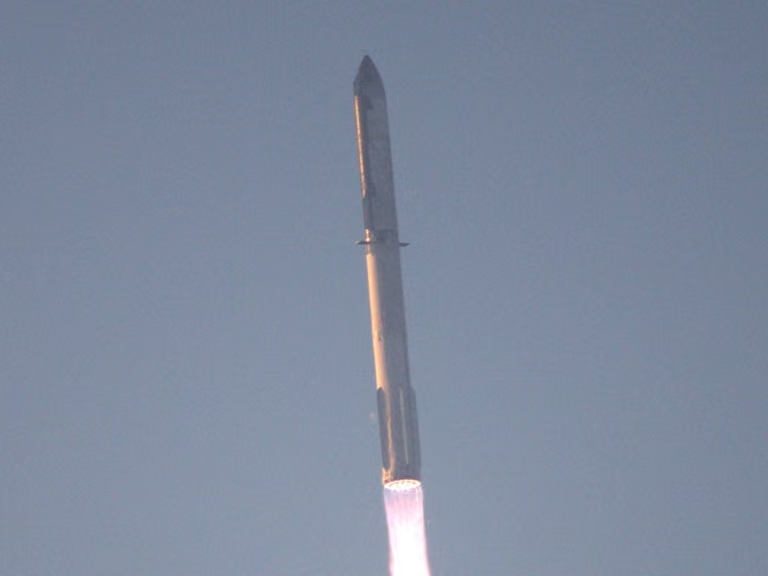
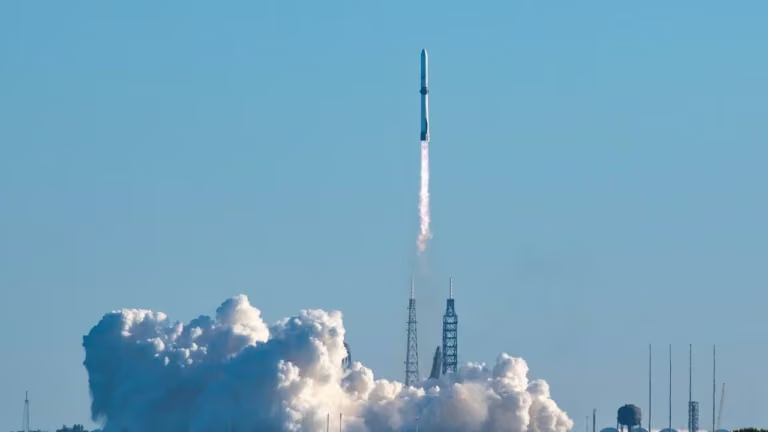
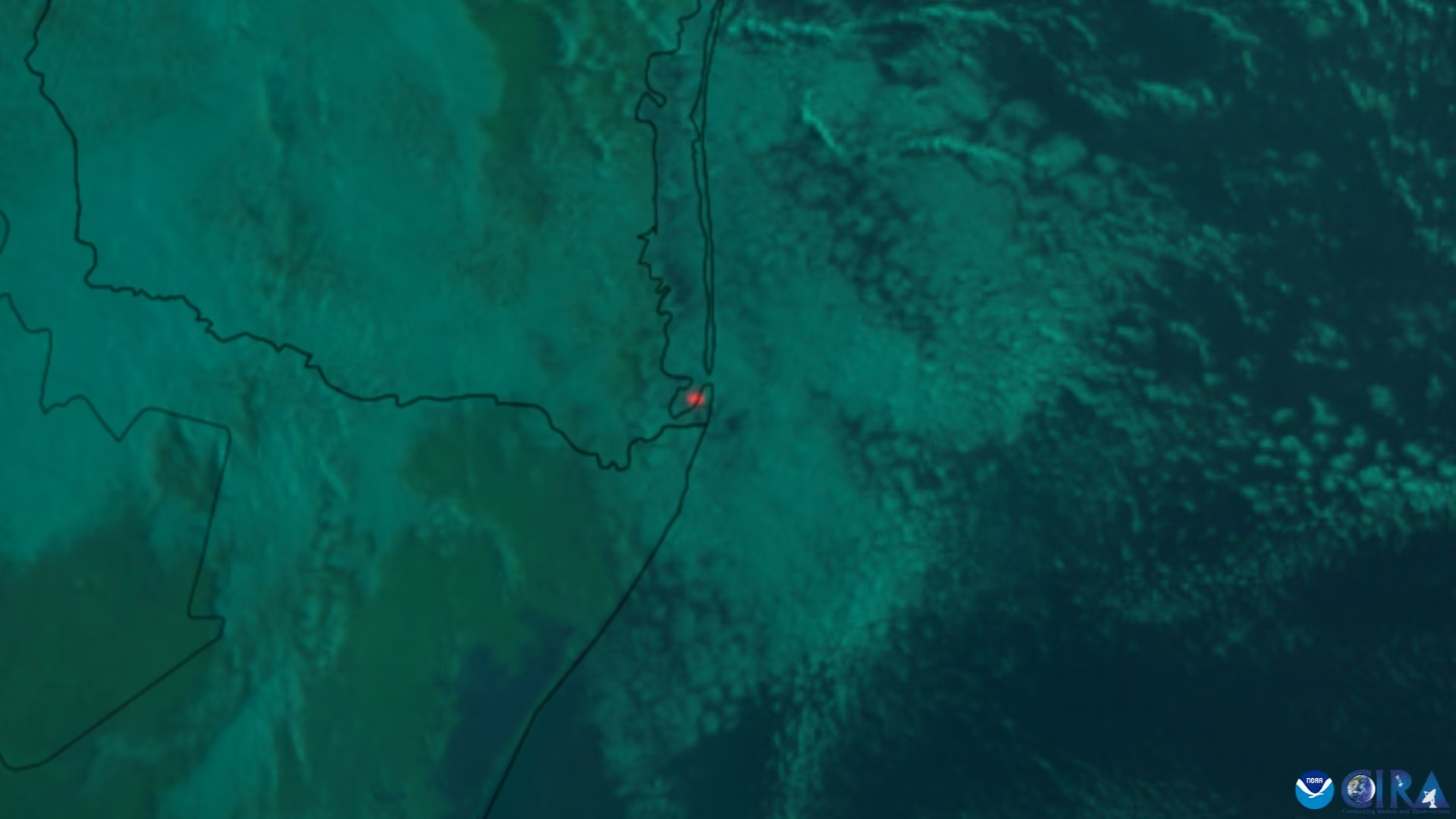
Starship flight 4 lifted off from Starbase, Texas, on Thursday, June 6, 2024, at 7:50 a.m. local time (8:50 a.m. Eastern). It was the first flight in which both stages finished their trips under control, and the Super Heavy booster made a soft landing in the Gulf of Mexico. The ship came through the peak heating of reentry, though damaged, and splashed down in the Indian Ocean one hour and six minutes after liftoff. It was a success.
Flight 4 at a glance
| Item | Detail |
|---|---|
| Date and time | June 6, 2024, 12:50 UTC (7:50 a.m. CDT at Starbase) |
| Site | Starbase, Texas, orbital launch pad OLP-1 |
| Booster | Super Heavy Booster 11 (B11), Block 1 |
| Ship | Starship Ship 29 (S29), Block 1 |
| Payload | None |
| Ship trajectory | Suborbital, with an apogee of about 213 km (132 mi) |
| Duration | 1 hour, 6 minutes and 10 seconds |
| Result | Success: booster and ship splashed down under control |
What the test was meant to show
SpaceX said the payload of the test was data. The two main goals were easy to state. The booster would simulate a landing at a “virtual tower,” a point just above the Gulf, and the ship had to survive at least the peak heating of reentry. The profile was similar to flight 3, without the propellant transfer, the payload door and the in-space engine relight.
There were two design novelties. The booster’s hot-staging ring would be jettisoned right after the boostback burn, to save weight on the way down. And SpaceX removed two tiles from the ship’s heat shield and swapped one for a thinner tile, on purpose, to measure the heat where there is no protection.
What happened, in order
The launch was planned for June 5 and slipped one day. The FAA approved the license on June 4, after concluding, on May 28, that flight 3 had not threatened public safety.
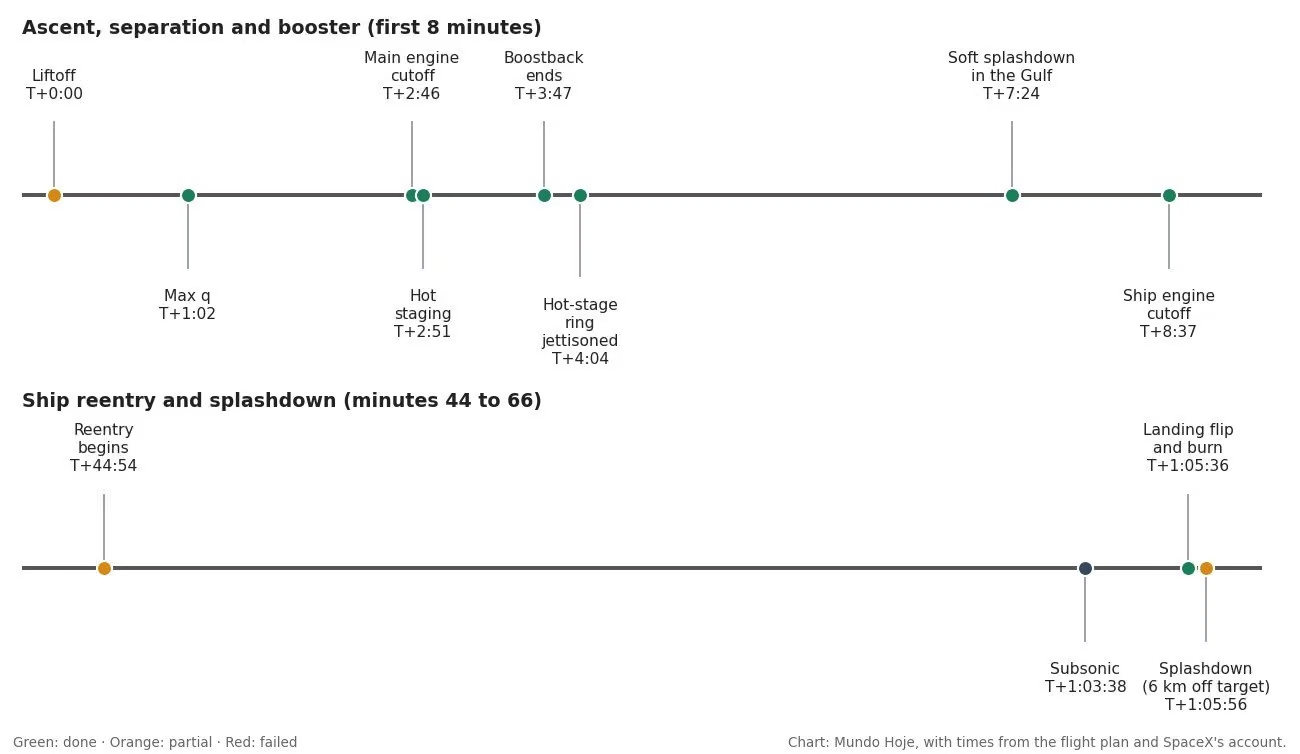
- Ascent: one of the booster’s 33 engines shut down early on, without affecting the flight. Hot staging came at 2 min 51 s.
- Booster: it flipped, ran the boostback burn and released the staging ring. In the landing burn, 12 of 13 engines lit. The soft landing in the Gulf came at 7 min 24 s. Afterward, the booster tipped over and broke up in the water.
- Ship, ascent: all six engines completed the burn, and the ship followed its planned trajectory.
- Reentry: the ship lost tiles and showed visible damage to its structure and flaps. Even so, it kept attitude control. Live Starlink video showed the plasma and the damage to the end. The ship was damaged.
- Splashdown: the ship lit its three center engines, flipped, ran the landing burn and splashed down softly. It arrived 1 hour and 6 minutes after launch, about 6 km from the target point, according to Elon Musk.
Objective by objective
| Objective | Result |
|---|---|
| Booster landing at the “virtual tower” | Done: soft landing in the Gulf |
| Survive peak heating on reentry | Done, with visible damage |
| Control the ship with flaps on descent | Done |
| Ship landing flip and burn | Done |
| Splashdown at the target point | Partial: about 6 km off center |
| All booster engines | Almost: one failed on ascent and one in the landing burn |
What the FAA required
For flight 4, the FAA listed three outcomes that would not trigger a mishap investigation. They were the ship burning up on reentry, the flaps not giving enough control and the Raptors not relighting for landing. Nothing outside that list happened. On June 12, the FAA announced it would not require an investigation, because everything occurred within planned and authorized activities, according to Wikipedia. It was the first Starship flight with no investigation. On flight 3, the accident had required one.
What changed for flight 5
The two results gave SpaceX the basis for the next step. In April, the company had said that if the virtual landing worked, it would try on flight 5 to catch the booster with the tower’s arms. Instead of landing on water, it would have to hit a much smaller target. Pieces of Booster 11’s engine section were recovered from the sea in September 2024. Flight 5 took place on October 13, 2024, with Booster 12 and Ship 30. See Starship flight 5.
Quick glossary
- Virtual tower: a point just above the water where the booster simulated the landing that would later happen at the tower.
- Hot-staging ring: a structure on top of the booster that vents the gases of the ship’s engines at separation.
- Flaps: the ship’s fins, which steer it as it descends through the atmosphere.
- Tiles: heat shield pieces that protect the ship from the heat of reentry.
- Splashdown: a landing in the sea.
- Peak heating: the moment in reentry when the ship’s heating is greatest.
Common mix-ups
- “The ship landed intact”: it splashed down softly, but with visible damage and lost tiles.
- “The booster was recovered”: no. It tipped over and broke up in the water; only pieces were found months later.
- “It was the first orbital flight”: the trajectory was still suborbital, with an apogee of about 213 km.
- “There were no problems”: engines failed and the ship was damaged, but all within what the FAA already accepted.
The rule to keep
A flight can have defects and still be a success. Here, both stages came back under control, and the problems were on the list of what the FAA accepted, which is why there was no investigation.
Quick questions
When was Starship flight 4?
June 6, 2024, at 7:50 a.m. at Starbase.
Did Starship land?
Yes, but on water. Both stages made soft landings at sea, with no legs and no tower.
Why was there no investigation?
Nothing went outside the outcomes the FAA had planned for and accepted.
When was flight 5?
October 13, 2024.
Previous flight: Starship flight 3
Sources: Starship’s Fourth Flight Test, SpaceX, June 6, 2024; Starship flight test 4, Wikipedia. Accessed on November 26, 2026. Eastern time calculated from UTC.
Featured image: NOAA/CIRA, public domain, via Wikimedia Commons. Text image: Mundo Hoje chart, with SpaceX data.