Starship flight 2: hot staging and the loss of both vehicles
Updated on November 26, 2026.
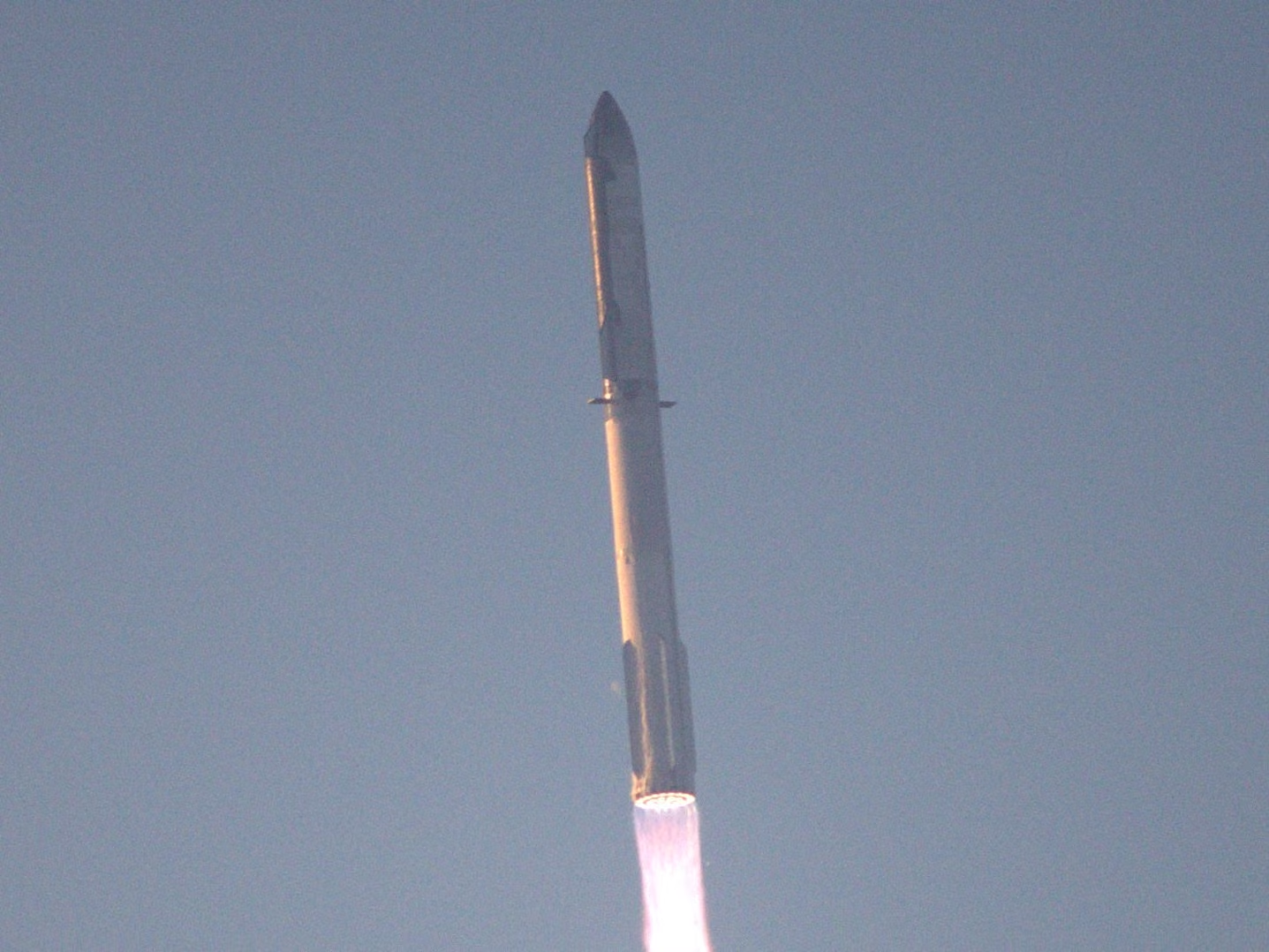
Starship flight 2 lifted off from Starbase, Texas, on Saturday, November 18, 2023, at 7:02 a.m. local time (8:02 a.m. Eastern). It was the first flight in which the ship lit its own engines while still attached to the booster in order to separate from it, a technique called hot staging. It was also the first time a Starship reached space, but both vehicles were lost. The booster exploded at about three and a half minutes, and the ship was destroyed by command after more than eight minutes of flight, near the end of its burn. No one was on board, and the FAA reported no injuries or damage to public property.
Flight 2 at a glance
| Item | Detail |
|---|---|
| Date and time | November 18, 2023, 13:02:50 UTC (7:02 a.m. CST at Starbase) |
| Site | Starbase, Texas, orbital launch pad OLP-1 |
| Booster | Super Heavy Booster 9 (B9), Block 1 |
| Ship | Starship Ship 25 (S25), Block 1 |
| Payload | None (the ship carried extra propellant as a payload stand-in) |
| Ship peak altitude | About 150 km (93 mi), at about 24,000 km/h |
| Duration | About 8 minutes (ship) and 3.5 minutes (booster) |
| Result | Both vehicles lost, with several milestones met |
What the test was meant to show
The main goal was to test hot staging. In this technique, the ship’s six engines light while it is still attached to the booster, and the thrust pushes the two apart. After that, the booster would turn back and make a powered landing in the Gulf of Mexico. The ship would fly a trajectory of nearly one orbit, with a controlled reentry over the Pacific near Hawaii and no landing burn.
Since flight 1, SpaceX had changed what the first flight exposed. The pad got a water-cooled steel flame deflector, and the booster’s fire suppression system was expanded. SpaceX also requalified the autonomous flight termination system, which had failed on the first test. Read what happened on flight 1.
What happened, in order
The target date was November 17. The FAA had approved the license on November 15, a day after the U.S. Fish and Wildlife Service finished its environmental review. On the 16th, the launch slipped 24 hours so a grid fin actuator on Booster 9 could be replaced.
- Ascent: the booster’s 33 Raptor engines lit and, for the first time, completed the full ascent burn. The water deflector worked.
- Max q (T+52 s): passage through peak air pressure, with no anomalies, according to the flight plan.
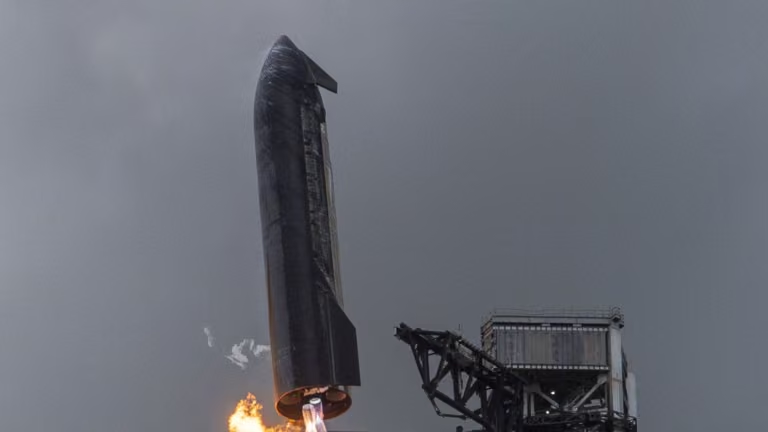
- Separation (T+2 min 41 s): the booster shut down all but three engines. The ship lit its six Raptors and separated, in the first successful hot staging of a vehicle this size.
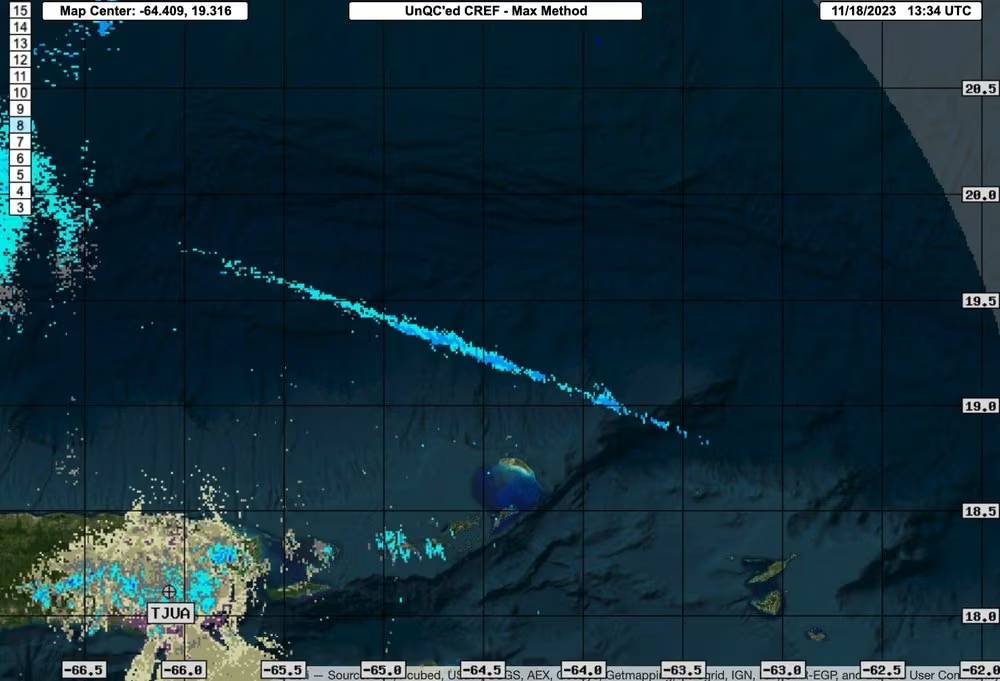
- Booster (about 3 min 30 s): it flipped and began its boostback burn, with 13 engines. Several shut down, one failed violently, and the booster broke apart about 90 km up over the Gulf.
- Ship (about 7 min): all six engines ran well until the planned dump of leftover liquid oxygen began.
- End (over 8 min): telemetry dropped near the end of the burn, and the flight termination system destroyed the ship at about 150 km and 24,000 km/h.
Objective by objective
| Objective | Result |
|---|---|
| Full ascent burn with 33 engines | Done, for the first time |
| Hot staging | Done |
| Booster return and landing in the Gulf | No: it broke apart at 3.5 minutes |
| Nearly one orbit with the ship | Almost: about 150 km, burn incomplete |
| Controlled reentry over the Pacific | Never reached |
| Pad left intact | Done: little repair needed |
The cause, according to the investigation
SpaceX led the investigation, with FAA oversight and participation from NASA and the National Transportation Safety Board (NTSB). The FAA closed it on February 26, 2024. According to the newspaper The Monitor, the agency demanded 17 corrective actions.
There were two separate problems, and on the booster the most likely cause was clogged filters where liquid oxygen reaches the engines. Inlet pressure at the turbopumps dropped, and one engine failed in a way that destroyed the vehicle. SpaceX changed the filtering inside the oxidizer tanks of upcoming boosters.
On the ship, the problem came from dumping extra liquid oxygen, loaded as a payload stand-in. The dump was planned, but a leak in the aft section, which appeared when it began, caused combustion and fires. The flight computers lost contact, all six engines were shut down by command, and the flight termination system detected a violation of a mission rule.
What changed for flight 3
SpaceX announced improvements against leaks, better fire protection and adjustments to the ship’s propellant-dump procedure. The next launch, flight 3, took place on March 14, 2024, with Booster 10 and Ship 28. See Starship flight 3.
There was also a consequence beyond space. In December 2023, the U.S. Federal Communications Commission denied an $885 million subsidy to Starlink. It cited that all attempts to launch Starship had failed, according to Wikipedia.
Quick glossary
- Hot staging: a separation in which the ship’s engines light before it releases from the booster.
- Boostback: the burn that sends the booster back toward its landing point.
- Grid fin: a surface that steers the booster on the way down.
- Telemetry: data the vehicle sends to the ground team during flight.
- RUD: “rapid unscheduled disassembly,” SpaceX’s term for an explosion.
- Autonomous flight termination system: it destroys the vehicle when it breaks mission rules.
Common mix-ups
- “Flight 2 reached orbit”: no. The ship climbed to about 150 km and was destroyed before the end of its burn.
- “The pad was destroyed again”: SpaceX says the flame deflector and other upgrades performed as expected.
- “Both vehicles blew up for the same reason”: the causes differed: clogged filters on the booster and a leak on the ship.
- “It was the same as flight 1”: the first lost control at 85 seconds. This one got through separation.
The rule to keep
A test can fail and meet goals at the same time. Both vehicles were lost, but hot staging, the full burn of all 33 engines and the reinforced pad worked, and each failure came out with an identified cause.
Quick questions
When was Starship flight 2?
November 18, 2023. Liftoff came at 7:02 a.m. at Starbase.
Did Starship reach space?
Yes. The ship reached about 150 km in altitude.
Why did the booster explode?
Clogged liquid-oxygen filters dropped the pressure at the turbopumps, according to SpaceX.
When was flight 3?
March 14, 2024.
Previous flight: Starship flight 1
Sources: Starship’s Second Flight Test, SpaceX, November 18, 2023; Building on the success of Starship’s second flight test, SpaceX, February 26, 2024; Starship flight test 2, Wikipedia. Accessed on November 26, 2026. Eastern time calculated from UTC.
Featured image: Osunpokeh, CC BY-SA 4.0, via Wikimedia Commons. Text image: NOAA, public domain, via Wikimedia Commons.