Starship flight 9: the first reused booster
Updated on November 26, 2026.
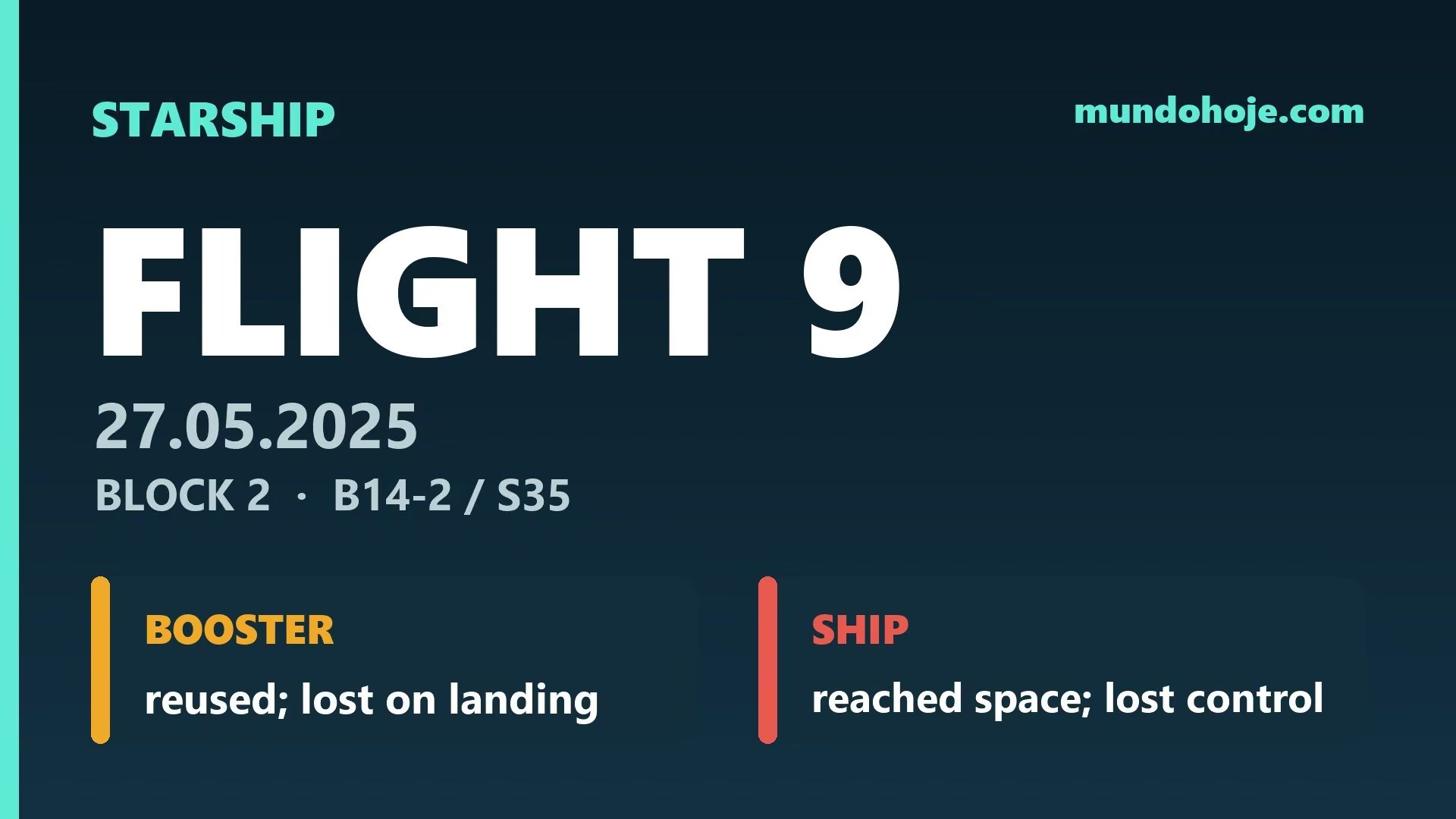
Starship flight 9 lifted off from Starbase, Texas, on Tuesday, May 27, 2025, at 6:36 p.m. local time (7:36 p.m. Eastern). It was the first flight in which SpaceX reused a Super Heavy booster, Booster 14, which had already flown on flight 7. The ship, Ship 35, completed its ascent burn to orbital velocity, something the previous two had not managed. After that, however, the payload bay door did not open and the ship lost control. It broke apart over the Indian Ocean, 46 minutes after liftoff. It was a mixed flight.
Flight 9 at a glance
| Item | Detail |
|---|---|
| Date and time | May 27, 2025, 23:36 UTC (6:36 p.m. CDT at Starbase) |
| Site | Starbase, Texas, orbital launch pad OLP-1 |
| Booster | Super Heavy Booster 14-2 (B14), reused from flight 7, Block 2 |
| Ship | Starship Ship 35 (S35), Block 2 |
| Planned payload | 8 Starlink satellite simulators, about 35,000 lb (16,000 kg) |
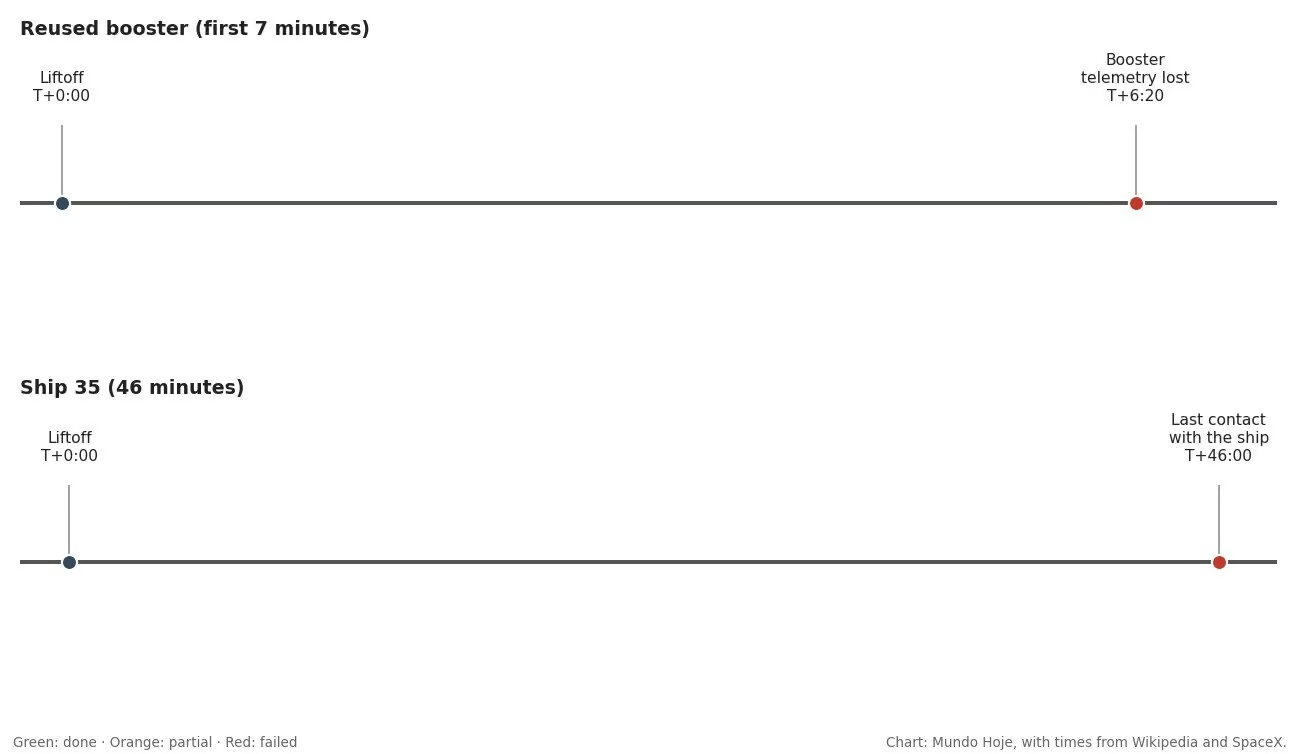
| Booster lost | Telemetry lost at 6 min 20 s, at about 3,300 ft (1 km) altitude |
| Ship lost | Last contact near 46 minutes into the flight |
| Result | Failure: booster and ship lost, with important data gathered |
What the flight was meant to test
The flight repeated the plan of flights 7 and 8, which had failed on the ship’s ascent. The ship was to release eight Starlink simulators and relight a Raptor in space before a splashdown in the Indian Ocean. The booster would not try a catch. It was to fall into the Gulf, after tests on the way down. One was landing at a higher angle of attack than normal. Another was deliberately not lighting one of the center engines.
It was the first reused booster. According to Wikipedia, 29 of its 33 engines had already flown, and one of them, number 314, was flying for the third time. The ship also carried changes after flight 8: more preload on key joints, a new nitrogen purge system and improvements to the propellant drain system.
What happened, in order
- Ascent: the booster’s 33 engines gave a normal ascent. Hot staging had a novelty: the booster moved away in a controlled direction, thanks to closed vents on the separation ring.
- Booster descent: it came down at a higher angle of attack, which raises drag and saves propellant on the landing burn. On that burn, 12 of the 13 engines lit.
- Booster end: contact was lost at 6 min 20 s, and the booster broke apart at about 1 km altitude. SpaceX said contact was lost shortly after the start of the landing burn. Wikipedia says the probable cause was excess stress on the internal fuel transfer tubes.
- Ship, ascent: all six engines completed the burn to orbital velocity. It was the first Block 2 ship to reach the planned speed.
- Failures in space: the payload bay door did not open, and the simulators were not released. An attitude control error made the ship skip the Raptor relight and miss the reentry position.
- Ship end: Elon Musk reported propellant leaks and a sudden loss of pressure, and the onboard computer started an automatic safing procedure. Contact ended near 46 minutes, and debris fell in the planned Indian Ocean area.
During reentry, images streamed over Starlink showed the ship tumbling through plasma, with parts damaged by the heat.
What the FAA required
On May 22, the FAA had cleared a return to flight after reviewing the flight 8 report. After flight 9, on May 30, it required an investigation for the ship only, because it did not reenter as planned, although no debris fell outside the planned areas. The loss of the booster was left out, because the agency treats it as expected test damage. The investigation was closed on August 15.
Objective by objective
| Objective | Result |
|---|---|
| Reuse a Super Heavy booster | Done, for the first time |
| Descend at a higher angle of attack | Done, with data gathered |
| Ship ascent burn to the end | Done, the first for Block 2 |
| Release 8 Starlink simulators | No: the payload bay door did not open |
| Relight a Raptor in space | No: attitude control error |
| Controlled reentry and splashdown | No: the ship lost control |
What changed for flight 10
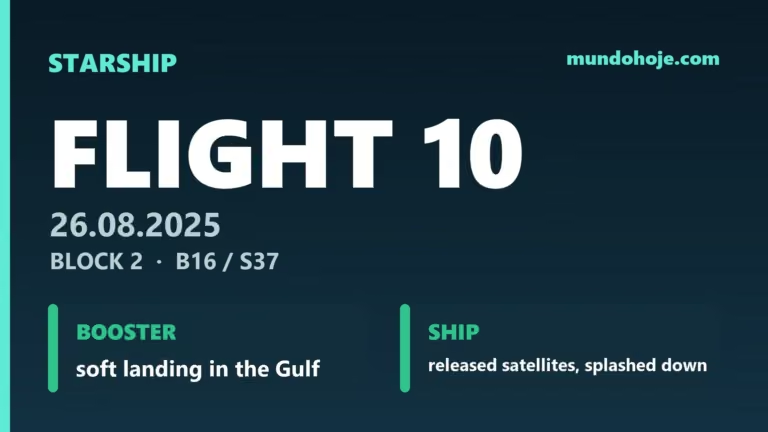
SpaceX prepared flight 10 with Booster 16 and Ship 37, on August 26, 2025. According to Wikipedia’s table, it was a success. It carried 8 Starlink simulators, and booster and ship stayed under control to the end. See Starship flight 10.
Quick glossary
- Reuse: flying again with a part already used on another flight.
- Angle of attack: the vehicle’s tilt relative to the air; the larger the angle, the more drag.
- Nitrogen purge: an inert gas used to clear lines and avoid dangerous mixing.
- Payload bay door: the ship’s opening through which the satellites would exit.
- Automatic safing procedure: the ship vents its remaining pressure to enter reentry in the safest condition.
Common mix-ups
- “Flight 9 was a total failure”: no. It had the first reuse of a booster and the first full ascent of a Block 2.
- “Losing the booster proves reuse does not work”: the flight tested extreme conditions on purpose, and the FAA treated the loss as expected test damage.
- “The ship entered orbit”: it reached orbital velocity, but the planned trajectory ended with reentry over the Indian Ocean.
The rule to remember
A flight can complete half the script and still teach a lot. Reusing the booster and the full ascent of the ship were milestones. The payload bay door and attitude control remained as tasks for the next flight.
Quick questions
When was Starship flight 9?
On May 27, 2025, at 6:36 p.m. local time at Starbase.
Was the booster caught?
No. There was no catch attempt. It was to fall into the Gulf and broke apart at about 1 km altitude.
Why did the ship fail?
The payload bay door did not open, an attitude error prevented the relight, and leaks led to a loss of control.
When was flight 10?
On August 26, 2025.
Previous flight: Starship flight 8
Sources: Starship’s Ninth Flight Test, SpaceX, May 27, 2025; Starship flight test 9, English Wikipedia; List of Starship launches, English Wikipedia. Accessed November 26, 2026. Eastern time calculated from UTC.
Featured image and text image: Mundo Hoje graphics, with data from SpaceX and Wikipedia.