Starship flight 12: the debut of Block 3 and Pad 2
Updated on November 27, 2026.
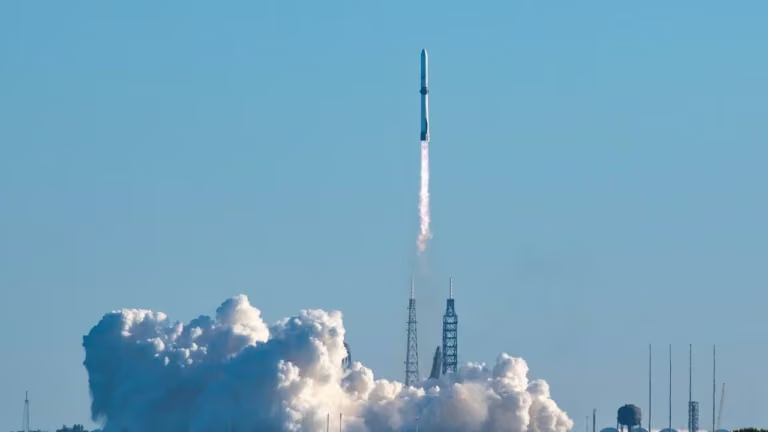
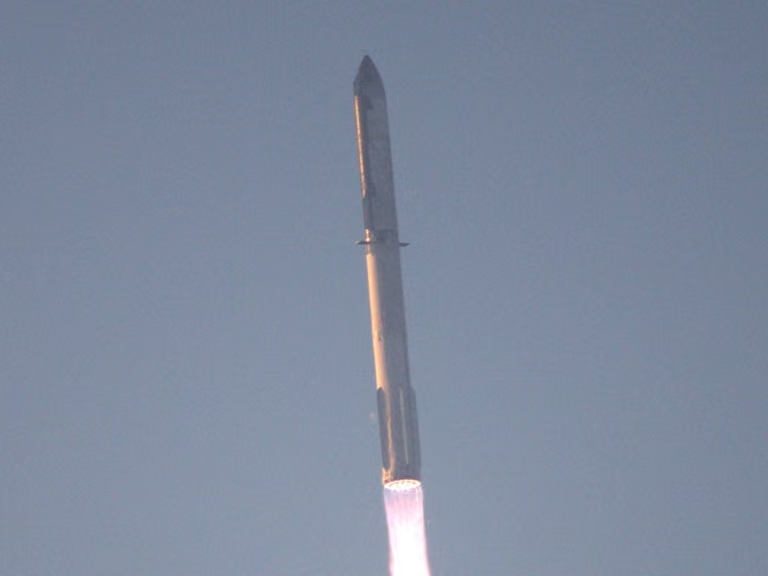
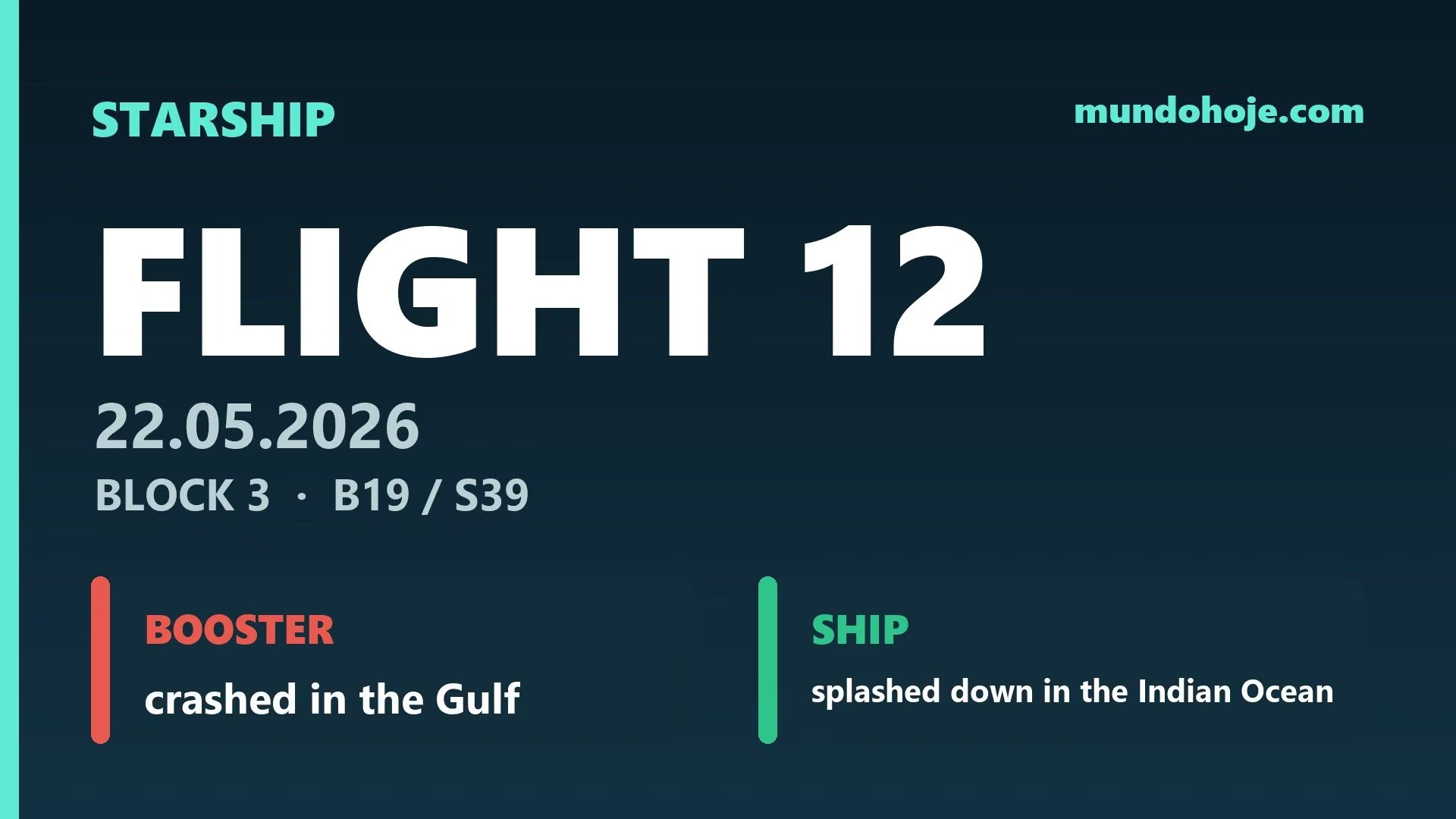
Starship flight 12 lifted off from Starbase, Texas, on Friday, May 22, 2026, at 5:30 p.m. local time (6:30 p.m. Eastern). It was the first flight of the third generation of vehicles, Block 3, also called V3, with Raptor 3 engines. It was also the first launch from Pad 2, OLP-2. The ship released 20 Starlink satellite simulators and two modified satellites, and splashed down in the Indian Ocean. The booster, however, crashed in the Gulf without completing its landing burn. It was a mixed flight, coming more than seven months after flight 11, the last of the previous generation.
Flight 12 at a glance
| Item | Detail |
|---|---|
| Date and time | May 22, 2026, 22:30 UTC (5:30 p.m. CDT at Starbase) |
| Site | Starbase, Texas, orbital launch pad OLP-2, its first use |
| Booster | Super Heavy Booster 19 (B19), Block 3, with 33 Raptor 3 engines |
| Ship | Starship Ship 39 (S39), Block 3 |
| Payload | 20 Starlink simulators and 2 modified Starlink satellites, about 82,700 lb (37,500 kg) |
| Ship trajectory | Suborbital, with a splashdown in the Indian Ocean |
| Duration | A little over 1 hour and 5 minutes |
| Result | Mixed: ship splashed down; booster crashed in the Gulf |
Before the flight
It had been 221 days since flight 11, the longest gap in the series, longer even than the roughly seven months between flights 1 and 2. The flight was planned for a different booster. Booster 18 was destroyed on November 21, 2025, in an ambient pressure test. According to Wikipedia, a pressure vessel in one of the side fins failed, and Booster 19 took its place.
The first attempt, on May 21, was scrubbed because a hydraulic pin on the launch tower’s quick disconnect arm did not retract, according to Wikipedia. The second worked. It came 24 hours later.
What the flight was meant to test
It was a lot of novelty at once. SpaceX highlighted four debuts: the V3 vehicles, the Raptor 3 engines, Pad 2 and modified Starlink satellites, built to photograph Starship in space during the flight. The profile was similar to flight 11’s. The booster would do the flip, the boostback burn and the landing burn. The ship would release the simulators, try to relight a Raptor and make its reentry, with tests on the flaps.
What happened, in order
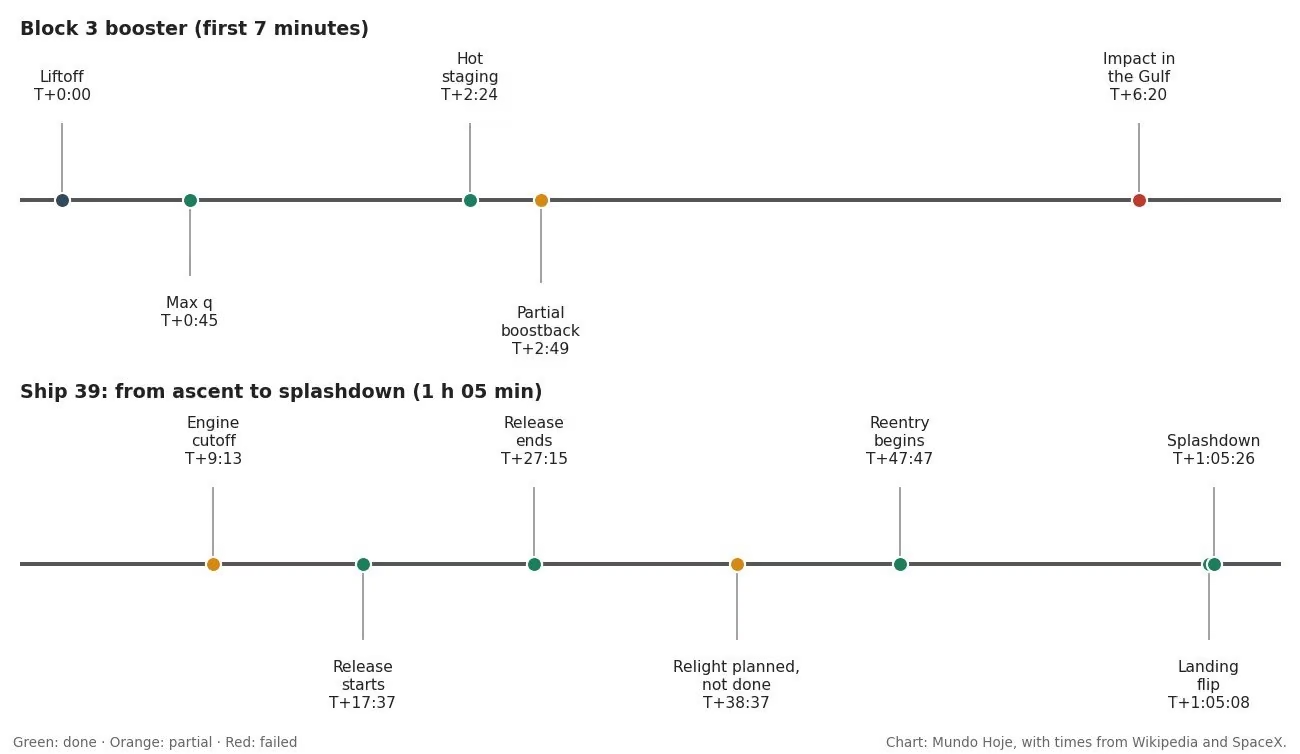
- Ascent: all 33 Raptor 3 engines lit, and one of them shut down during the climb. According to SpaceX, the first stage still completed its ascent successfully. Hot staging came at 2 min 24 s, by SpaceX’s timeline.
- Booster, return: after the directional flip, it could not light all the planned engines. The boostback burn was partial and ended early.
- Booster, landing: it tried to relight for the landing burn, but only one engine lit, according to Wikipedia. There was a hard impact in the Gulf, at about 900 mph (1,450 km/h).
- Ship, ascent: one of the Raptor 3 vacuum engines failed. The ship showed it can fly with one engine fewer and met its planned trajectory. According to Wikipedia, the burn had to run longer to compensate.
- Satellites: the release of the 20 simulators and the two modified satellites took place between 17 min 37 s and 27 min 15 s. All followed the ship’s same suborbital trajectory. The two modified ones photographed Starship in space.
- Relight: SpaceX’s timeline had the test at 38 min 37 s, but the official summary does not say it was done. Wikipedia lists it as cancelled, because of the engine lost earlier.
- Reentry: it began at 47 min 47 s. In the final minutes, the ship made a maneuver to push the limits of its rear flaps and a dynamic banking move, imitating the path back to Starbase.
- Splashdown: transonic at 1 h 02 min 29 s, subsonic at 1 h 03 min 08 s. The landing flip came at 1 h 05 min 08 s, the burn dropped from 3 to 2 and then to 1 engine, and the ship touched the ocean at 1 h 05 min 26 s, as planned.
What failed on the booster
According to Wikipedia, the booster flipped abnormally fast after separation, and that made most of its engines fail. Only one lit on the landing burn. It fell into the Gulf at high speed, instead of coming back near the pad, as planned.
What the FAA required
According to Wikipedia, the FAA declared the Super Heavy failure a mishap on May 27 and required SpaceX to investigate. It also kept Starship grounded. Flights would resume only after the investigation. Flight 13 did not happen until July 24, 2026, two months later.
Objective by objective
| Objective | Result |
|---|---|
| Debut Block 3 and Raptor 3 | Done |
| Launch from pad OLP-2 | Done, the first time |
| Booster ascent and separation | Done, with one engine fewer |
| Booster boostback and landing burns | No: partial and no controlled landing |
| Ship ascent to the trajectory | Done, with one Raptor fewer |
| Release 20 simulators and 2 modified satellites | Done |
| Photograph the ship in space | Done, by the two modified satellites |
| Relight a Raptor in space | No, according to Wikipedia |
| Reentry, flaps and dynamic banking | Done, with data collected |
| Splashdown in the Indian Ocean | Done |
What changed for flight 13
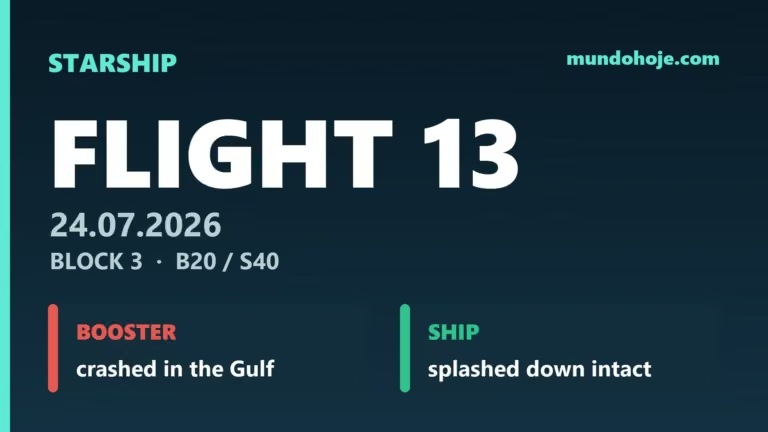
Flight 13 was on July 24, 2026, with Booster 20 and Ship 40. By Wikipedia’s table, the booster failed its landing again, and the ship stayed under control. See Starship flight 13.
Quick glossary
- Block 3 (V3): the third version of Starship, with Raptor 3.
- Raptor 3: the third generation of the Raptor engine.
- OLP-2: Starbase’s second launch pad.
- Boostback burn: the burn that takes the booster back toward the Starbase area.
- Engine out: the ability to finish the mission even with one engine shut down.
Common mix-ups
- “Flight 12 failed”: it was mixed. The ship did almost everything; the booster did not.
- “The satellites reached orbit”: no. They followed the ship’s same suborbital trajectory.
- “The ship relit its engine”: SpaceX does not say so, and Wikipedia lists the test as cancelled.
The rule to remember
Debuting everything at once has a price. Flight 12 showed that the Block 3 ship can take the loss of an engine. The costliest lesson went to the booster, exactly the part SpaceX wants to recover.
Quick questions
When was Starship flight 12?
On May 22, 2026, at 5:30 p.m. local time at Starbase.
What was new?
Block 3, the Raptor 3 engines and Pad 2, plus the modified satellites that photographed the ship.
Was the booster recovered?
No. It crashed in the Gulf after a partial boostback burn.
When was flight 13?
On July 24, 2026.
Previous flight: Starship flight 11 · Next flight: Starship flight 13 · All flights: All Starship flights
Sources: Starship’s Twelfth Flight Test, SpaceX, May 22, 2026; Starship flight test 12, English Wikipedia; List of Starship launches, English Wikipedia. Accessed November 27, 2026. Eastern time calculated from UTC; flight times are SpaceX’s approximate ones.
Featured image and text image: Mundo Hoje graphics, with data from SpaceX and Wikipedia.