Starship flight 10: satellites released and ship splashdown
Updated on November 26, 2026.
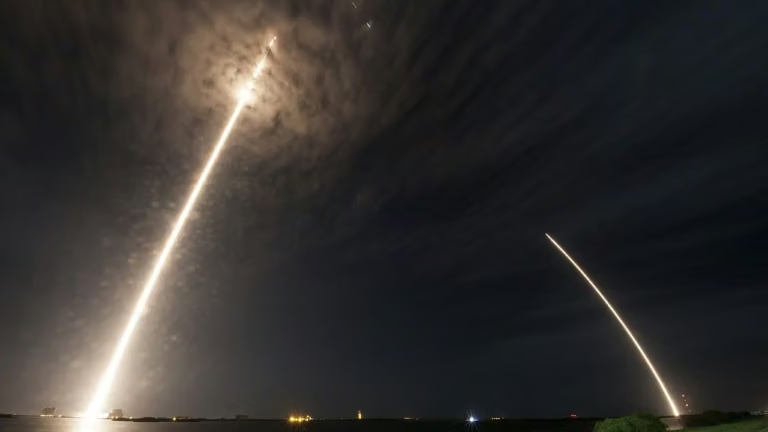
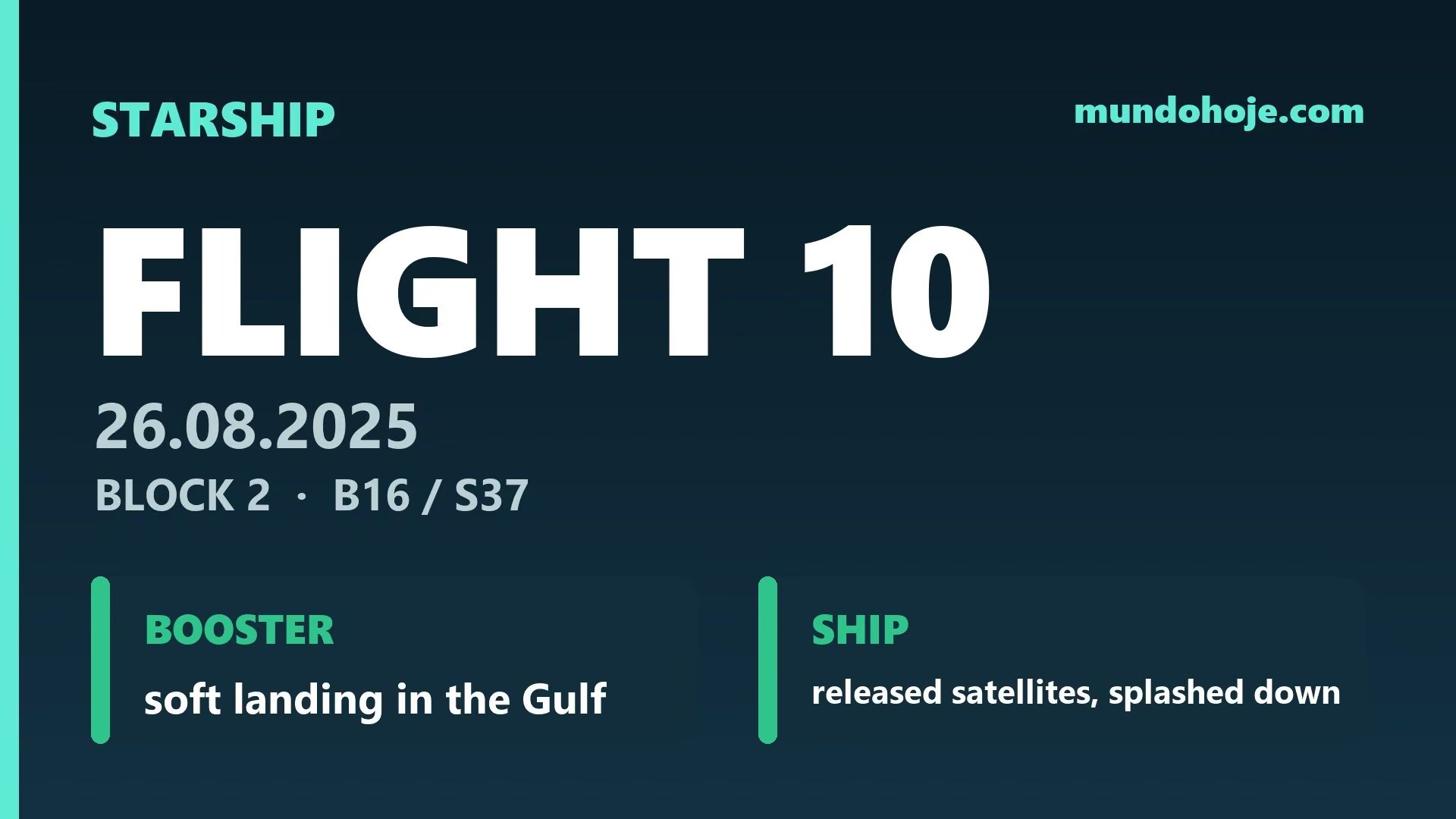
Starship flight 10 lifted off from Starbase, Texas, on Tuesday, August 26, 2025, at 6:30 p.m. local time (7:30 p.m. Eastern). It was the flight in which the ship, Ship 37, released a payload in space for the first time, eight Starlink satellite simulators, and relit a Raptor engine. It then crossed reentry and splashed down in the Indian Ocean, 1 hour and 6 minutes after liftoff. SpaceX said all the main objectives were met. It was the first Block 2 flight classed as a success.
Flight 10 at a glance
| Item | Detail |
|---|---|
| Date and time | August 26, 2025, 23:30 UTC (6:30 p.m. CDT at Starbase) |
| Site | Starbase, Texas, orbital launch pad OLP-1 |
| Booster | Super Heavy Booster 16 (B16), Block 2 |
| Ship | Starship Ship 37 (S37), Block 2 |
| Payload | 8 Starlink satellite simulators, about 35,000 lb (16,000 kg) |
| Ship trajectory | Suborbital, with a splashdown in the Indian Ocean |
| Duration | About 1 hour, 6 minutes and 30 seconds |
| Result | Success: booster and ship splashed down under control |
Before the flight
The flight was set for late June 2025. On June 18, Ship 36 exploded at the test site during propellant loading for an engine test, with severe damage to the area. Initial analysis said a nitrogen tank in the ship’s nose cone burst below its rated pressure. Ship 37 was then assigned to flight 10. The FAA closed the report on flight 9 on August 15, and the way was clear.
The first launch attempt was scrubbed because of an oxidizer line leak in the ground systems. The second was called off because of anvil clouds near the site. The third went on August 26. It worked.
What the flight was meant to test
The plan was almost the same as flight 9’s. The booster would do a separation with a controlled flip and test a landing with one engine fewer. One of the three center engines would be disabled on purpose, and a backup from the middle ring would take over. The ship would release eight Starlink simulators and relight a Raptor in space.
What happened, in order
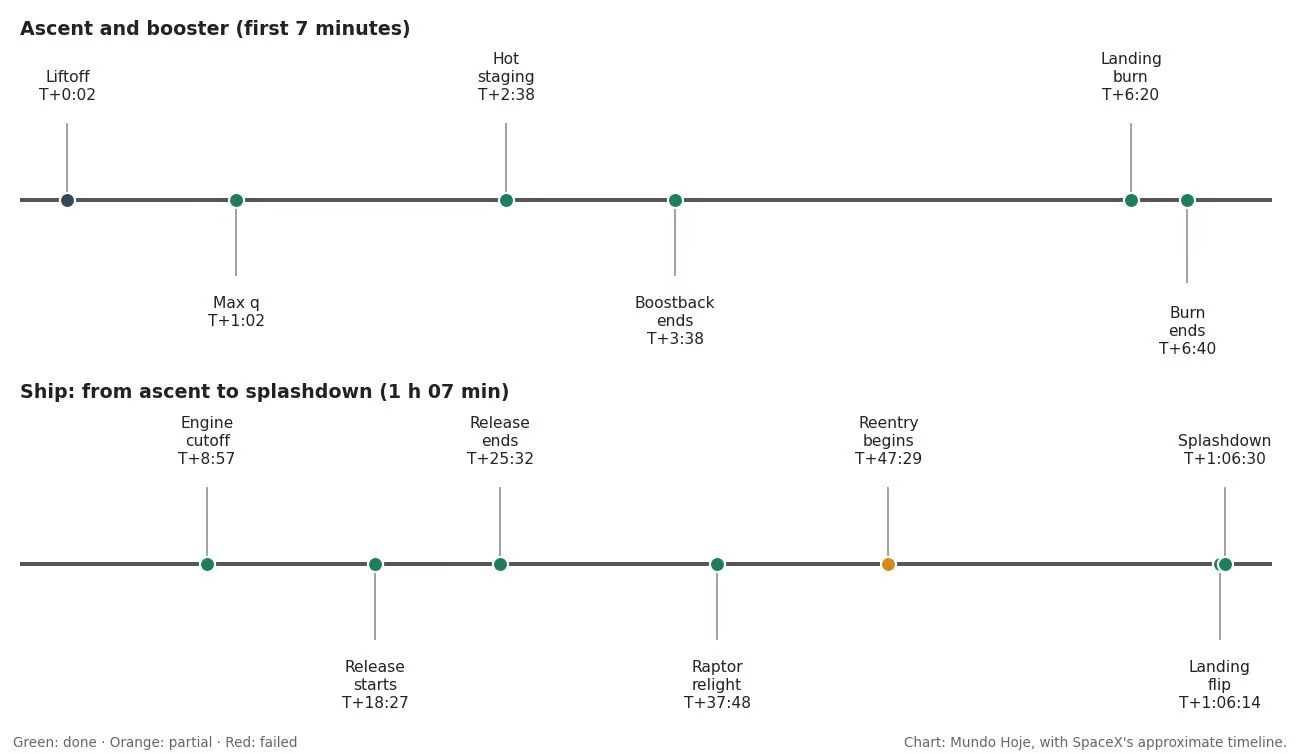
- Ascent: liftoff was at 2 s, maximum aerodynamic pressure at 1 min 02 s, and hot staging at 2 min 38 s. One of the booster’s engines shut down early and did not relight afterward.
- Booster: it did its boostback burn between 2 min 48 s and 3 min 38 s. On the landing burn, from 6 min 20 s to 6 min 40 s, it used the backup engine. It hovered over the water, shut down and dropped into the Gulf, where it exploded on impact. The descent used a less aggressive angle of attack than flight 9’s, which had been identified as a factor in the loss of that booster.
- Ship, ascent: engine cutoff came at 8 min 57 s, at the planned speed.
- Satellites: the release demonstration began at 18 min 27 s and ended at 25 min 32 s. It was the first successful payload demonstration from Starship.
- Relight: at 37 min 48 s, a Raptor relit in space, the second relight in history.
- Reentry: it began at 47 min 29 s. The ship went transonic at 1 h 03 min 15 s and subsonic at 1 h 04 min 30 s, steered by its four flaps.
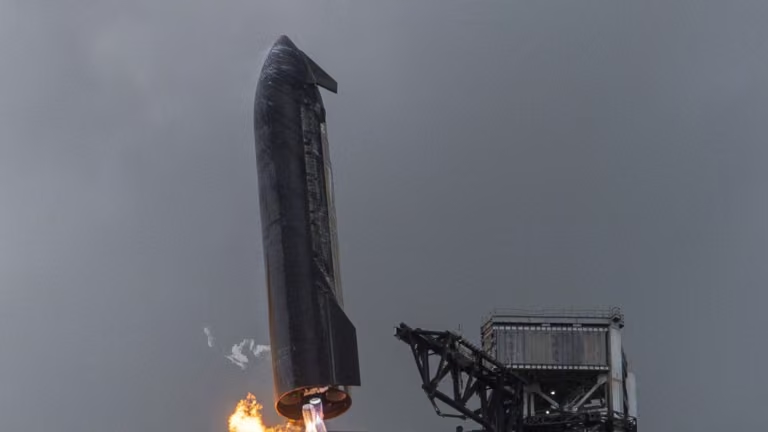
- Splashdown: the landing flip came at 1 h 06 min 14 s and the landing burn six seconds later. The ship hovered over the ocean, tipped over and destroyed itself on impact, as planned. A buoy filmed the scene.
What reentry revealed
Around 47 minutes, at about 90 km altitude, an explosion in the engine compartment damaged the ship’s aft skirt. According to Wikipedia, the cause was blocked engine chill lines, followed by combustion. There was also heat wear on the inner edge of the aft flaps. Even so, the ship survived. It made the planned landing. SpaceX says the shield and structure were pushed to their limits on purpose, to gather data on how the ship performs in difficult conditions.
Objective by objective
| Objective | Result |
|---|---|
| Ship ascent to the planned speed | Done |
| Release 8 Starlink simulators | Done, the first release in flight |
| Relight a Raptor in space | Done |
| Reentry controlled by the flaps | Done, with damage to the aft skirt |
| Flip, landing burn and splashdown | Done, in the planned zone |
| Booster landing with one engine fewer | Done, soft in the Gulf |
What changed for flight 11
Flight 11 was on October 13, 2025, with Booster 15, flying for the second time, and Ship 38. According to Wikipedia’s table, it was a success and the last with the Block 2 version. See Starship flight 11.
Quick glossary
- Payload release: the ship opens its door and drops the satellites or, here, simulators.
- Maximum aerodynamic pressure: the moment of greatest stress from the air on the rocket.
- Transonic and subsonic: speed ranges near the speed of sound and below it.
- Chill lines: pipes that cool the engines before ignition.
- Aft skirt: the lower part of the ship that surrounds the engines.
Common mix-ups
- “The simulators were real satellites”: they were parts with the weight and shape of a Starlink, built to burn up on reentry.
- “It was perfect”: no. There was damage to the aft skirt and a booster engine that did not relight.
- “The ship landed intact”: it splashed down and destroyed itself on impact, as planned.
The rule to remember
Meeting every objective does not mean flying without problems. Flight 10 was a success because the defects that appeared stayed within what the vehicle could take, and the ship finished the script.
Quick questions
When was Starship flight 10?
On August 26, 2025, at 6:30 p.m. local time at Starbase.
What was new?
The first payload release in flight and a booster landing with one engine fewer.
Was the ship recovered?
No. It splashed down in the Indian Ocean and destroyed itself on impact, as planned.
When was flight 11?
On October 13, 2025.
Previous flight: Starship flight 9
Sources: Starship’s Tenth Flight Test, SpaceX, August 26, 2025; Starship flight test 10, English Wikipedia; List of Starship launches, English Wikipedia. Accessed November 26, 2026. Eastern time calculated from UTC; flight times are SpaceX’s approximate ones.
Featured image and text image: Mundo Hoje graphics, with data from SpaceX and Wikipedia.