Starship flight 8: third booster catch and another ship loss
Updated on November 26, 2026.
Starship flight 8 lifted off from Starbase, Texas, on Thursday, March 6, 2025, at 5:30 p.m. local time (6:30 p.m. Eastern). The tower caught the Super Heavy booster for the third time. The ship, Ship 34, lost four engines at 8 minutes and 4 seconds, lost control and broke apart, as on the previous flight. It was the second failure in a row for a Block 2. The flight went only on its second try, after a countdown was aborted three days earlier.
Flight 8 at a glance
| Item | Detail |
|---|---|
| Date and time | March 6, 2025, 23:30:31 UTC (5:30 p.m. CST at Starbase) |
| Site | Starbase, Texas, orbital launch pad OLP-1 |
| Booster | Super Heavy Booster 15 (B15), Block 2 |
| Ship | Starship Ship 34 (S34), Block 2 |
| Planned payload | 4 Starlink satellite simulators, about 18,000 lb (8,000 kg) |
| Planned trajectory | Suborbital, with a splashdown in the Indian Ocean |
| Ship lost | Engines shut down from 8 min 04 s; last contact near 9 min 30 s |
| Result | Ship failure; booster caught by the tower |
Before the flight
After flight 7, SpaceX announced on February 24, 2025 that it had finished its investigation. The FAA approved the license, with changes based on the results, on February 26.
The first attempt was on March 3. SpaceX aimed for 23:45 UTC, but after propellant loading, undisclosed problems arose on both vehicles. The count stopped at 40 seconds. It resumed, and then flight computers detected new problems. The launch was scrubbed. It returned three days later.
What the flight was meant to test
The plan resembled that of flight 7: catch the booster and fly the ship to a splashdown in the Indian Ocean. The ship would release four Starlink satellite simulators, built to destroy themselves on reentry. There would be only four.
What happened, in order
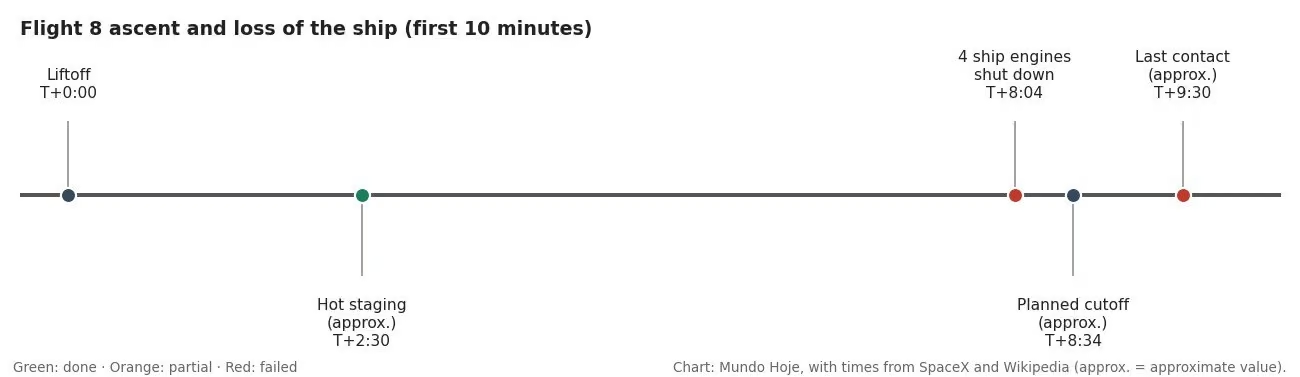
- Ascent: the booster’s 33 engines gave a normal ascent. About two and a half minutes later, it shut down all but three for hot staging, and the ship lit its six Raptors.
- Booster return: on the boostback burn, 11 of the 13 planned engines relit, two fewer than planned. Even so, SpaceX gave the go-ahead for the catch.
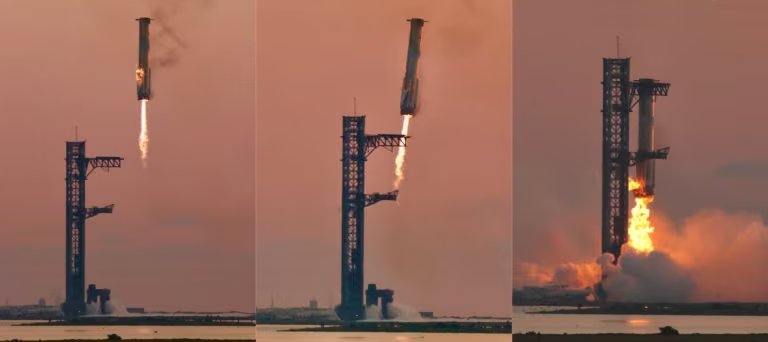
- Catch: on the landing burn, 12 of 13 engines lit, and the three center engines kept running to bring the booster to the tower arms. It was the third catch of a Super Heavy.
- Ship: four engines, one vacuum and three sea-level, began shutting down at 8 min 04 s, about 30 seconds before the planned cutoff.
- End: the ship lost attitude control and SpaceX lost contact. The last signal came near 9 min 30 s. After that, the ship was seen breaking up over Florida and the Bahamas.
The ending was seen from the Bahamas and Florida, and also from Jamaica and the Turks and Caicos Islands. SpaceX said the flight stayed inside its authorized corridor, that debris would fall in the planned response area and that there were no toxic materials.
Why the ship was lost
According to SpaceX, an energetic event in the aft of the ship led to the loss of several Raptors. Wikipedia reports that the most likely cause was the failure of a part in a sea-level Raptor. Propellant mixed and ignited, and there was a fire in the engine bay. That failure was different from flight 7’s. It was a new defect.
The double relight failure on the booster was tied to ignition problems caused by unfavorable thermal conditions. The FAA ordered an investigation into the ship’s loss. On May 22, 2025, it cleared a return to flight after reviewing the report. On June 12, it announced the closure of the case, with 8 corrective actions verified before flight 9.
Objective by objective
| Objective | Result |
|---|---|
| Booster catch | Done, for the third time |
| Ship ascent to the end of the burn | No: engines shut down at 8 min 04 s |
| Release 4 Starlink simulators | Never done |
| Splashdown in the Indian Ocean | Never reached |
What changed for flight 9
Flight 9 was on May 27, 2025. It carried Ship 35, 8 Starlink simulators and a reused booster, Booster 14, flying for the second time. According to Wikipedia’s table, the flight was classed as a failure, with the booster lost in the Gulf and the ship lost in the ocean. See Starship flight 9.
Quick glossary
- SECO: the main engine cutoff of the ship, at the end of ascent.
- Attitude: the ship’s orientation in space; losing it means losing control.
- Sea-level Raptor: a ship engine built to run with air around it, unlike the vacuum ones.
- Satellite simulator: a part with the weight and shape of a Starlink, built to burn up on reentry.
- Scrubbed count: the launch is cancelled in the middle of the countdown.
Common mix-ups
- “Flight 8 repeated flight 7’s failure”: no. The cause was different: a part in a sea-level Raptor.
- “The booster failed too”: no. It was caught, even with two fewer engines on the boostback burn.
- “People were hurt”: SpaceX reported no injuries and no toxic materials in the debris.
The rule to remember
Two failures in a row on the ship, with different causes, show that a new version needs many flights to be fixed. The booster, by contrast, had already been caught on three of the four previous flights, from 5 to 8.
Quick questions
When was Starship flight 8?
On March 6, 2025, at 5:30 p.m. local time at Starbase.
Was the booster recovered?
Yes. The tower caught it, for the third time.
Why did the ship fail?
Four engines shut down on ascent, and the most likely cause was the failure of a part in a sea-level Raptor.
When was flight 9?
On May 27, 2025.
Previous flight: Starship flight 7
Sources: Starship’s Eighth Flight Test, SpaceX, March 6, 2025; Starship flight test 8, English Wikipedia; List of Starship launches, English Wikipedia. Accessed November 26, 2026. Eastern time calculated from UTC.
Featured image: NASA/JSC/Don Pettit, public domain, via Wikimedia Commons. Text image: Mundo Hoje chart, with SpaceX data.