Starship flight 11: the last flight of the second generation
Updated on November 26, 2026.
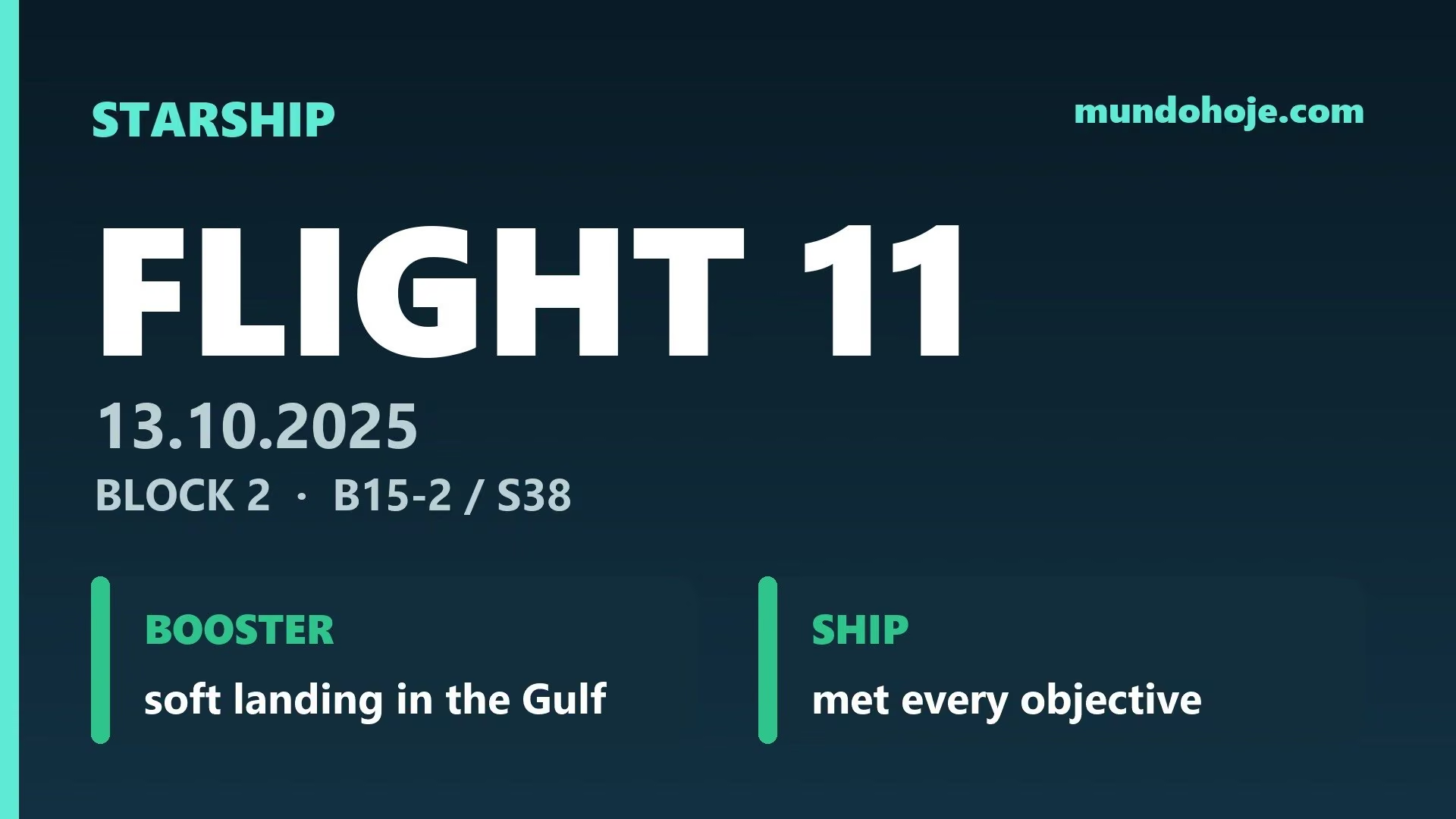
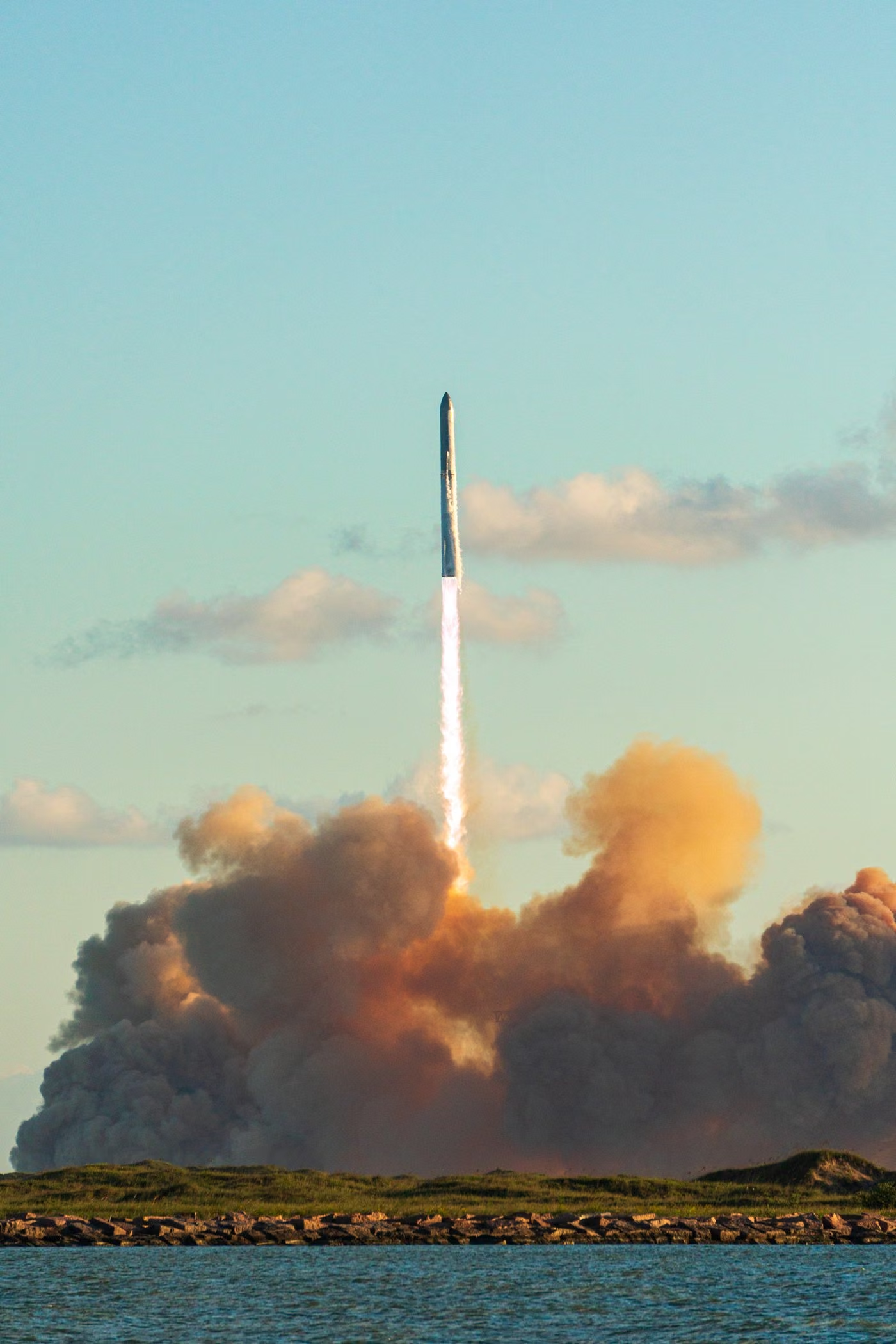
Starship flight 11 lifted off from Starbase, Texas, on Monday, October 13, 2025, at 6:23 p.m. local time (7:23 p.m. Eastern). It was the last flight of the ship’s second generation, Block 2, and of the first-generation Super Heavy booster. It was also the last launch from the then-existing configuration of Pad 1. SpaceX said all the main objectives were met. The ship released eight Starlink satellite simulators, relit a Raptor in space and splashed down in the Indian Ocean, 1 hour, 6 minutes and 25 seconds after liftoff.
Flight 11 at a glance
| Item | Detail |
|---|---|
| Date and time | October 13, 2025, 23:23 UTC (6:23 p.m. CDT at Starbase) |
| Site | Starbase, Texas, orbital launch pad OLP-1 |
| Booster | Super Heavy Booster 15-2 (B15), on its second flight, Block 2 |
| Ship | Starship Ship 38 (S38), Block 2 |
| Payload | 8 Starlink satellite simulators, about 35,000 lb (16,000 kg) |
| Ship trajectory | Suborbital, with a splashdown in the Indian Ocean |
| Duration | About 1 hour, 6 minutes and 25 seconds |
| Result | Success: booster and ship splashed down under control |
What the flight was meant to test
The profile repeated that of flight 10. The booster, which had already flown on flight 8 and carried 24 previously used engines, would test configurations planned for the Block 3 boosters before being discarded in the Gulf. The ship would release eight simulators, relight a Raptor and go through heat shield tests.
According to Wikipedia, the tests included removing tiles that have no backup protective layer. It was a way to measure what happens when the shield is pushed to its limit.
What happened, in order
- Ascent: all 33 engines lit, and hot staging came at 2 min 39 s, according to SpaceX’s timeline.
- Booster return: the boostback burn used 12 of the 13 planned engines. On the way down, at the same angle of attack as the previous flight, the booster lit all 13 at the high-thrust part of the landing burn, including the one that had not relit before.
- Booster landing: it made a new landing burn, planned for the next generation of boosters, hovered over the water, shut down its engines and dropped into the Gulf, between about 6 min 20 s and 6 min 36 s.
- Ship, ascent: the engines shut down at 8 min 58 s, at the planned speed and trajectory.
- Satellites: the release of the 8 simulators began at 18 min 28 s and ended at 25 min 33 s.
- Relight: at 37 min 49 s, the ship relit a Raptor in space, the third in-flight relight in history.
- Reentry: it began at 47 min 43 s. The ship made a dynamic banking maneuver in the final minutes, to imitate the path future ships will follow when they return to Starbase.
- Splashdown: the landing burn began at 1 h 05 min 58 s, the flip came two seconds later, and the ship touched the ocean at 1 h 06 min 25 s.
What SpaceX says it learned
SpaceX says the ship gathered a lot of data on the heat shield, pushed to its limit on purpose. The dynamic banking maneuver imitated the flight back that the next ships will make. The booster, for its part, tested the landing burn the company plans to use on the next generation.
Objective by objective
| Objective | Result |
|---|---|
| Ship ascent to the planned speed | Done |
| Release 8 Starlink simulators | Done |
| Relight a Raptor in space | Done, the third in flight |
| Reentry with heat shield tests | Done, with data collected |
| Dynamic banking maneuver | Done |
| New booster landing burn | Done, with a soft landing in the Gulf |
What changed for flight 12
After flight 11, Block 2 was retired. Flight 12, on May 22, 2026, debuted Block 3, with Booster 19 and Ship 39, and left from pad OLP-2. By Wikipedia’s table, it was a success for the ship, with 20 Starlink simulators and 2 modified Starlink satellites, but the booster failed its landing. See Starship flight 12.
Quick glossary
- Block 2: the second version of Starship, used on flights 7 to 11.
- Dynamic banking: a maneuver in which the ship tilts its body sideways on the way down, imitating the flight back to Starbase.
- Ablative tile: a heat shield piece that wears away on purpose to protect the structure.
- OLP-1: the Starbase launch pad used up to flight 11.
- Discarded booster: a booster that will not be recovered and falls into the sea.
Common mix-ups
- “Flight 11 was the last Starship flight”: it was the last of Block 2; the series went on with Block 3.
- “The booster was caught”: no. It was planned to land in the Gulf, softly.
- “It was the same as flight 10”: the profile was similar, but it included the dynamic banking maneuver and a new landing burn.
The rule to remember
Two successes in a row close out a version. Flight 11 wrapped up Block 2 with every objective met. The main lesson was left for the next generation: how the heat shield and the landing burn behave.
Quick questions
When was Starship flight 11?
On October 13, 2025, at 6:23 p.m. local time at Starbase.
What was new?
A dynamic banking maneuver by the ship and a new landing burn by the booster.
Was the ship recovered?
No. It splashed down in the Indian Ocean, as planned.
When was flight 12?
On May 22, 2026.
Previous flight: Starship flight 10
Sources: Starship’s Eleventh Flight Test, SpaceX, October 13, 2025; Starship flight test 11, English Wikipedia; List of Starship launches, English Wikipedia. Accessed November 26, 2026. Eastern time calculated from UTC; flight times are SpaceX’s approximate ones.
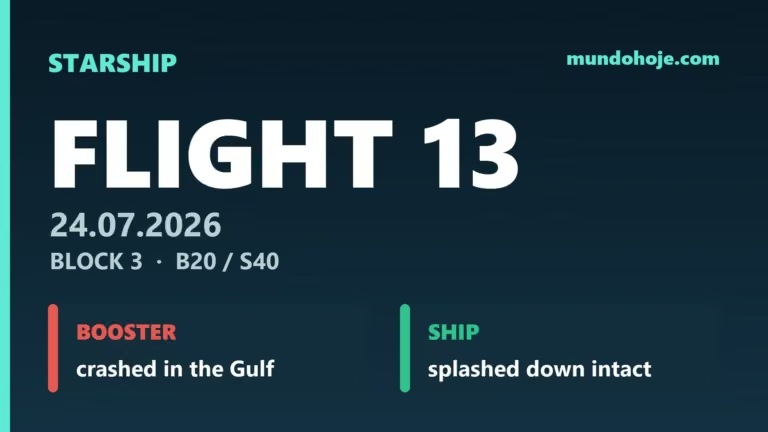
Featured image: Mundo Hoje graphic, with data from SpaceX and Wikipedia. Text image: Shujianyang, CC BY-SA 4.0, via Wikimedia Commons.