China’s Space Program: Tiangong, Chang’e and a Moon Landing by 2030
Updated November 2, 2026.
China has its own space station, Tiangong. It has also brought back samples from the far side of the Moon, which no one had done before. Its stated goal is to put astronauts on the lunar surface before 2030. Between the station in orbit and that goal lie missions in progress and delays, along with several points that still lack a confirmed date from any official source.
The Tiangong station
Tiangong was assembled in orbit from three modules, one at a time, and the first up was the core module, Tianhe, launched on April 29, 2021. Wentian arrived on July 24, 2022. Mengtian launched on October 31, 2022. The station was complete when it docked on November 3 of that year. It weighs about 100 metric tons.
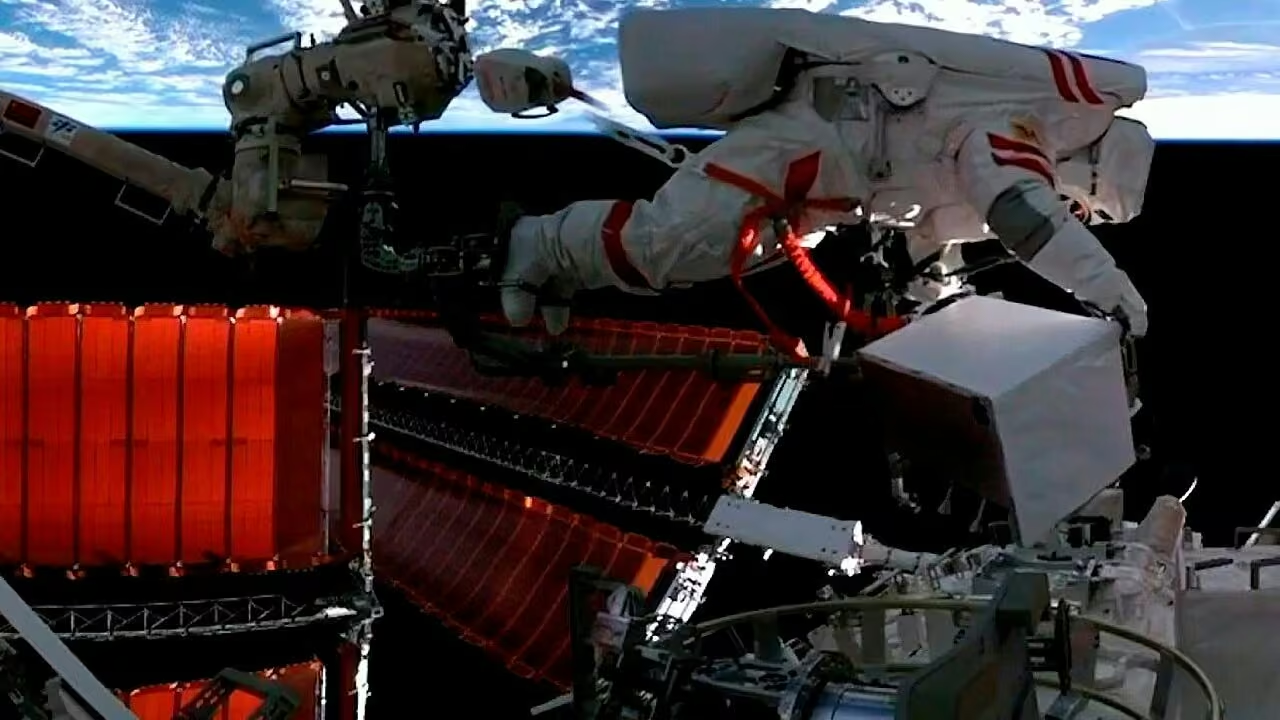
The normal crew is three people. At handovers it can reach six for a few days, until the previous crew heads home. Astronauts fly on Shenzhou spacecraft, which lift off from the Jiuquan launch center.
In November 2025, Shenzhou-20 was damaged by space debris, and the crew returned to Earth on November 14 aboard Shenzhou-21. It was a real test of the emergency plan, and the plan worked.
Shenzhou-23 lifted off from Jiuquan on May 24, 2026, with Zhu Yangzhu, Zhang Zhiyuan and Lai Ka-ying, the first astronaut from Hong Kong. One crew member is expected to spend a full year in orbit to test long stays.
The Chang’e missions to the Moon
China’s lunar program is named after the Moon goddess. In January 2019, Chang’e-4 landed on the far side, a world first. In 2020, Chang’e-5 brought back 1.73 kilograms of material. Chang’e-6 landed on the far side on June 25, 2024. It returned with 1,935.3 grams of samples.
Chang’e-7 was scheduled for August 24, 2026, bound for the lunar south pole. The Associated Press reported that China abruptly postponed the launch. I found no confirmed new date, and some reports point to 2027.
Astronauts on the Moon before 2030
On May 23, 2026, according to the Xinhua news agency, China’s crewed space program presented a unified lunar plan. The goal is to land astronauts on the Moon before 2030. So far, China has carried out an in-flight abort test of the Mengzhou spacecraft and a low-altitude test of the Long March 10 rocket. The lunar lander is called Lanyue.
| Date | Milestone |
|---|---|
| January 2019 | Chang’e-4 lands on the far side of the Moon |
| April 29, 2021 | Tianhe module launches |
| November 3, 2022 | Tiangong is complete, with Mengtian docked |
| June 25, 2024 | Chang’e-6 lands on the far side and collects 1,935.3 g |
| May 24, 2026 | Shenzhou-23 launches |
| 2030 (goal) | Chinese astronauts on the Moon |
Frequently asked questions
Does China have a space station?
Yes. It is Tiangong, complete since November 2022 with a standing crew of three. It belongs to China alone.
What is Chang’e-6?
A mission that landed on the far side of the Moon on June 25, 2024. The probe returned to Earth with 1,935.3 grams of lunar soil samples.
When does China plan to land astronauts on the Moon?
The official goal is before 2030, and the plan was detailed in May 2026. Tests of the Mengzhou spacecraft and the Long March 10 rocket have already begun.
Has Chang’e-7 launched yet?
No. It was scheduled for August 24, 2026. It was postponed. The sources I reviewed give no confirmed new date.
Does China take part in the ISS?
No. The country built Tiangong on its own, with modules made in China and launched from its territory.
Read next: The International Space Station: How It Works and When It Ends and Reusable Rockets: How They Work and Who Has Landed One.
Sources: Tiangong space station, Wikipedia; Shenzhou 23, Wikipedia; Chinese Lunar Exploration Program, Wikipedia; Chang’e 6, Wikipedia; The far side of the moon: Chang’e-6 marks new chapter, CGTN; China abruptly postpones ambitious Chang’e-7 lunar mission launch, NEXTA, citing the AP; Chang’e 7, Wikipedia.
Featured image: China Manned Space Engineering Office, CC BY 4.0, via Wikimedia Commons.