The International Space Station: How It Works and When It Ends
Updated November 2, 2026.
The International Space Station, or ISS, is a research laboratory that circles Earth about 250 miles (400 km) up. According to Wikipedia, people have lived aboard it without a break since November 2, 2000, which is more than 25 years. The station has an end date, because it is expected to operate through the end of 2030 and then be brought down in a controlled way.
Size and speed
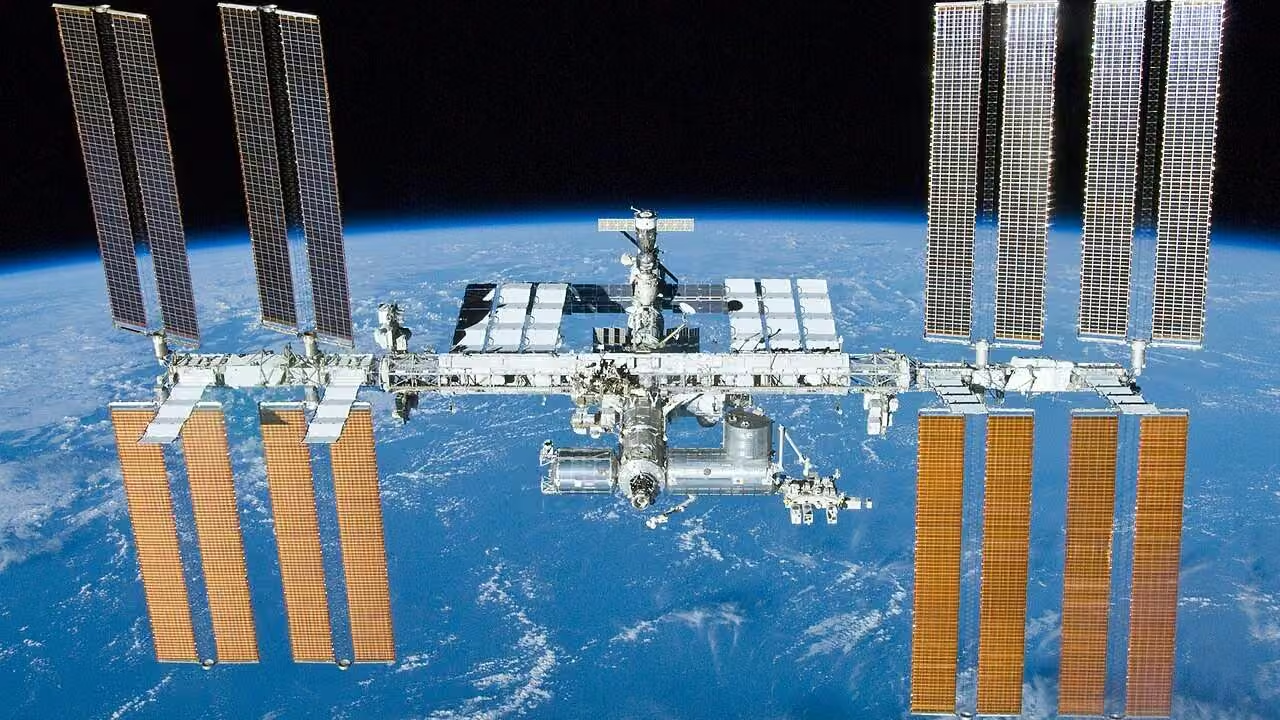
The first module, the Russian Zarya, launched on November 20, 1998, on a Proton rocket. Today the station weighs about 990,000 pounds (450,000 kg). With its solar arrays it measures about 357 feet long and 240 feet wide, a bit larger than a football field.
It travels at 4.8 miles per second, or about 17,150 mph, and one trip around Earth takes roughly 92.9 minutes. That adds up to about 15 and a half orbits a day. It is very fast.
Who runs it
Five space agencies share the project. NASA represents the United States and Roscosmos represents Russia, while the European Space Agency, Japan’s JAXA and the Canadian Space Agency complete the group. Each partner built different parts of the station, and Japan’s Kibo is the largest module, according to Wikipedia’s JAXA page. As of August 2025, 290 people from 26 countries had visited.
In November 2026, seven people live on board during Expedition 75. They arrived on Soyuz MS-29 and on SpaceX’s Crew-13, and the commander is the Russian cosmonaut Pyotr Dubrov.
When it ends
The current plan is to operate through the end of 2030. After that, a U.S. spacecraft built for the job, the US Deorbit Vehicle, is supposed to bring the station down, and Russia’s space chief said in April 2026 that the wind-down starts in 2028. Dates can change.
In 2026, a proposal to move the station to a higher, more stable orbit gained support in Congress. Wikipedia records no decision.
| Date | Milestone |
|---|---|
| November 20, 1998 | Zarya module launches |
| November 2, 2000 | Expedition 1 arrives, the first long-term crew |
| August 2025 | 290 people from 26 countries have visited |
| End of 2030 (planned) | Operations end and the station is deorbited |
Frequently asked questions
What is the International Space Station?
It is a space station assembled in orbit by five agencies. They are NASA and Roscosmos, along with the European, Japanese and Canadian agencies. It works as a science laboratory that never stops circling Earth.
How high does the ISS fly?
About 250 miles (400 km), between 413 and 422 km according to Wikipedia.
How many people live on the ISS?
Seven, as of November 2026, during Expedition 75. The number changes when crews rotate.
When will the ISS be retired?
It is expected to operate through the end of 2030 and then leave orbit. The date could shift.
Can I see the ISS from the United States?
Yes, on certain dates. It looks like a bright dot crossing the sky in a few minutes. Tracking sites list the times for your city.
Read next: NASA’s Artemis Program: Why America Is Going Back to the Moon and Exploring Mars: The Perseverance Rover and the Sample Problem.
Sources: International Space Station, Wikipedia; Roscosmos confirms the end of the ISS in 2030, ru1 (TASS), April 6, 2026.
Featured image: NASA/Crew of STS-132, Public domain, via Wikimedia Commons.